
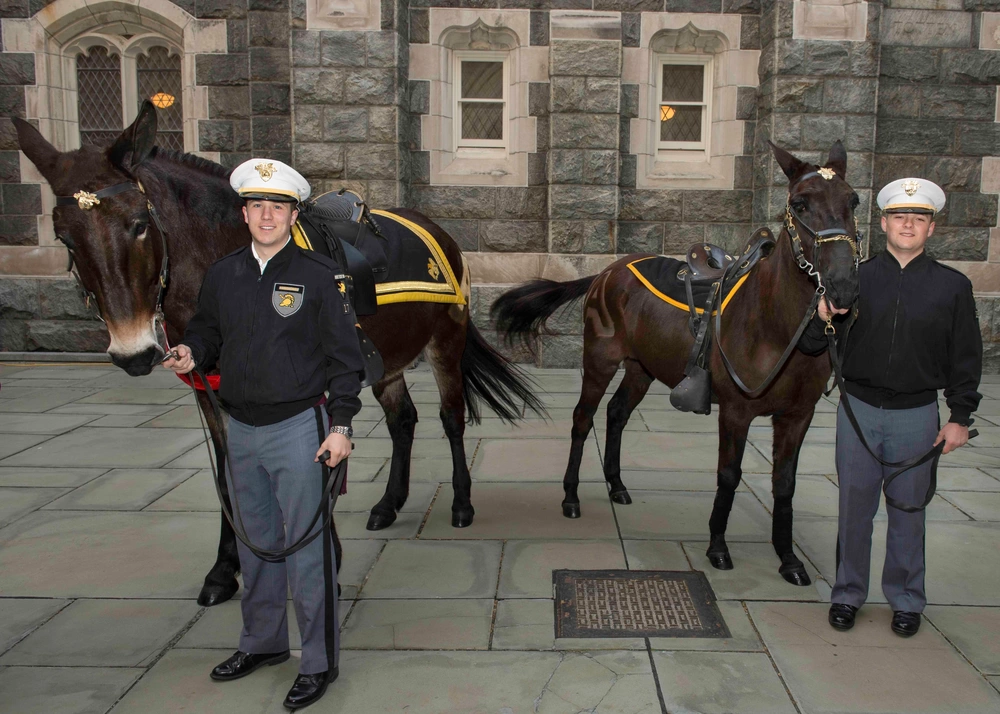
Featured photo: Army mule mascots with cadet handlers at West Point in 2016. This is a modern scene, not the 1899 ice-wagon mule. U.S. Army photo by John Pellino / West Point DPTMS VI via DVIDS.
Before Army had a mule on its sideline, Navy already had a goat. So in 1899, a Philadelphia quartermaster officer found Army a mascot with an unusually practical résumé: the big white mule had been pulling an ice wagon. Somebody cleaned him up, dressed him in Army colors and sent him to meet the goat. If that sounds like a story invented after a tailgate, the basic ice-wagon account comes from Army West Point Athletics.
The mule stayed. More than a century later, West Point still has live mule mascots and cadets who handle them. The choice makes sense once you look beyond the rivalry joke: mules hauled Army guns, ammunition and supplies through terrain that did not care about anyone’s schedule.
First, Navy showed up with a goat
Army and Navy played their first football game in 1890. Navy had the more experienced team and won 24–0 at West Point, according to the Army Military History Institute’s account. There are several goat-origin stories, so it is safest to say that Navy’s goat was already part of the rivalry by the time Army went shopping for an animal of its own.
Nine years after that first game, the teams met at Philadelphia’s Franklin Field. An officer at the Philadelphia Quartermaster Depot decided the Army side needed a mascot to answer Navy’s goat. According to West Point Athletics, he chose an oversized white mule that had been pulling an ice wagon. The animal was groomed, given leggings, a collar and a gray blanket, and decorated with black, gold and gray streamers. That is a lot of preparation for an animal whose previous duty station was a delivery route.
Did the mule really kick the goat?
The best part of the story needs a label. West Point’s cadet-athlete handbook calls it Military Academy legend: when the two mascots met, the mule supposedly sent the startled goat toward the Navy stands. The image is irresistible. It is also a story passed down as a legend, not a verified play-by-play from 1899.
The football result is easier to check. The Naval History and Heritage Command’s game scores record an Army win, 17–5, in Philadelphia that year. The mule did not score any of those points, at least according to the official record. But one victory plus one colorful mascot tale was enough to give Army an enduring symbol.
Why a mule fit the Army
Picking a mule was more than a joke at Navy’s expense. West Point Athletics describes the animal as a symbol of the pack mules that hauled guns, ammunition and supplies for the Army. Strong, sure-footed and stubborn enough to stop when something feels wrong, a mule is an unusually honest military mascot. It is less glamorous than a knight on horseback, but it understands logistics. Anyone who has waited for a supply truck knows logistics can decide the day.
The Army Quartermaster Museum’s history of horses and mules makes that connection concrete. One mule named Trotter had served with the 35th Quartermaster Pack Company at Fort Carson, Colorado. When the unit was deactivated in 1957, Trotter went to West Point. He was an actual former Army pack animal turned mascot, not a mascot created from a drawing. For Colorado readers, that is a small local footnote in a very East Coast football tradition.
From ice wagon to official duty
The 1899 ice-wagon mule started the tradition, but Army’s first official mule mascot arrived later. A U.S. Army history roundup identifies him as Mr. Jackson, a former Army pack mule who came to West Point in 1936. That distinction keeps two different stories from getting tangled: the first game-day mule and the first officially designated mascot were not the same animal.
The lineup has had unexpected additions. The same Army account says Buckshot, the only female among the official mules counted at the time of its 2016 article, arrived in 1964 as a gift from the Air Force Academy. Imagine telling a new cadet that one of Army’s football mascots came from Air Force. Interservice rivalry apparently has room for a useful gift.
The tradition is not limited to West Point, either. The Army’s 1st Theater Sustainment Command has its own mule mascot, Blackjack. An Army account of his handlers connects him to sustainment units and their working-animal history. The name is familiar around the command because the mascot shows up at unit events, not because he is secretly doing quartermaster paperwork.
The cadets behind the mules
At West Point, live mules are handled by cadet Mule Riders. The academy says a new rider is selected from the fourth class each spring for horsemanship, spirit and leadership, with cadets taking on more responsibility as they progress. That makes the mascot a small leadership job as well as a photo opportunity. The mules have to be cared for, trained and brought safely into loud public events.
A 2016 West Point photo on DVIDS shows cadets with the mules as Paladin joined the mascot team. It is a good reminder that there are real animals and real handlers behind the symbol. A costume mascot can take off its head after the game; a mule needs someone who knows how to work with it before and after the crowd goes home.
The joke stuck because the job was real
Most fans remember the ice wagon and the Navy goat. Soldiers may appreciate the deeper reason. For generations, getting a load across bad ground was the sort of unglamorous job that kept a force moving. The mule stood for that stubborn, necessary work long before it became a sideline celebrity.
So the next time Army’s mule appears on screen, you can tell a buddy the short version: it began with an ice wagon in 1899; the goat-kicking story is academy legend; the mascot has real Army pack-animal roots. If you like the strange paths military service can take, there are also service-academy football players who reached the NFL and Army ski troops who helped build Colorado ski towns. Army history has plenty of stories that sound made up until you check them.
Image-use note: DVIDS identifies the U.S. Army photograph as public domain. Its use does not imply Department of Defense endorsement.