
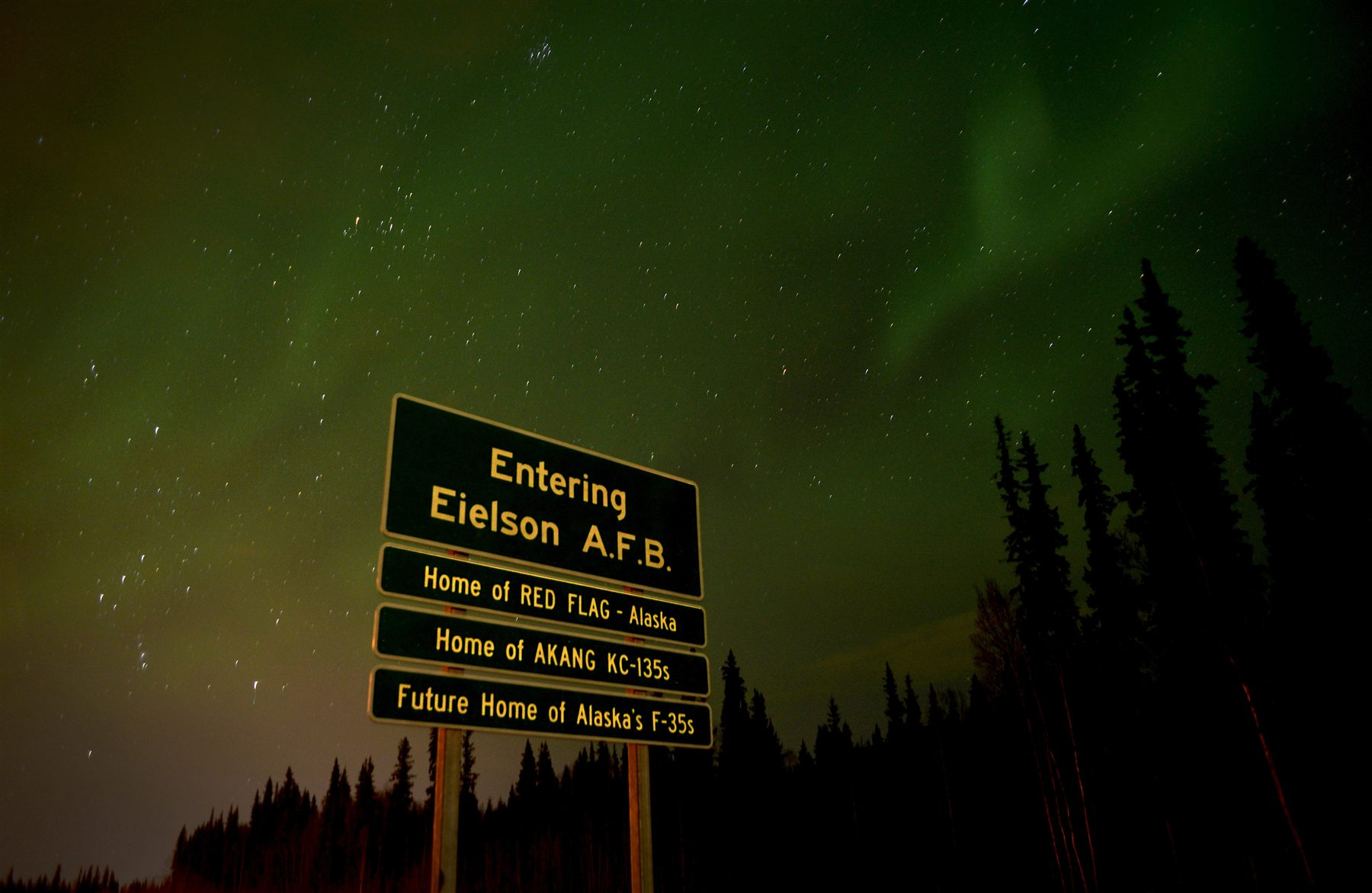
Featured photo: The northern lights above Eielson Air Force Base in 2018. Bob Ross served at Eielson decades earlier; this is a later scene, not a photo from his service. U.S. Air Force photo by Capt. Kay M. Nissen via DVIDS.
Picture Bob Ross speaking softly to a canvas about happy little trees. Now picture the same man as the first sergeant who could tell an airman to clean the latrine. Both pictures belong to the same life. Before he became the face of The Joy of Painting, Ross spent 20 years in the U.S. Air Force, and his time in Alaska helped shape the landscapes millions of people watched him paint.
From Florida to Alaska
Ross grew up in Florida and enlisted at 18. He served at Eielson Air Force Base near Fairbanks, Alaska, according to the Department of Veterans Affairs. A Florida kid suddenly surrounded by snow, mountains, enormous skies and the northern lights had no shortage of scenery. Those scenes would become familiar to anyone who later watched his television show.
He was not there as a professional artist. Biography reports that his early Air Force job involved medical records. His painting started off duty, when he took a class at an Anchorage USO club. The VA also records that class as the beginning of his interest in painting Alaskan landscapes. It is an almost perfect military side-project story: a service member finds a hobby far from home, then discovers that the hobby may be bigger than the day job.
The side hustle before the television show
Ross did not walk out of that first class ready to host a TV series. He kept learning and painting during his service. Biography reports that he sold landscapes to tourists, sometimes on gold-panning tins, and later studied the fast wet-on-wet oil-painting method associated with instructor Bill Alexander. Speed mattered: the technique let him finish a scene without waiting for each layer to dry. That practical skill eventually made a half-hour painting show possible.
Was Bob Ross really a drill sergeant?
That claim gets repeated online, but the documented role is Air Force first sergeant, not Army drill sergeant. The distinction matters. Ross described the disciplinarian side of his job in a 1990 Orlando Sentinel interview, quoted by the VA: he was “the guy who makes you scrub the latrine.” That is a very different image from the gentle TV host, but it does not mean every internet story about him screaming at recruits is true.
Ross apparently disliked having to play the tough guy. Biography’s account of the interview says he wanted his next career to feel different. It is reasonable to hear that contrast in his calm television manner, but reducing his whole personality to “the military made him whisper” goes further than the evidence. The more interesting point is that he chose how he wanted to address people when the uniform came off.
He retired, then bet on painting
Ross retired from the Air Force in 1981 after two decades of service, according to the official Bob Ross UK biography. The Joy of Painting began in 1983 and ran through 1994, according to PBS. It is easy to compress those dates into a neat success story. There was still a risky gap between leaving a steady military career and becoming a recognizable television teacher.
His show was built on a simple invitation: pick up a brush and try. He painted mountains, trees and water in a way that made a beginner think, “Maybe I could do that.” His military background did not disappear; the Alaskan scenery remained on the canvas. But the new job let him lead by encouragement rather than by enforcing a standard.
Alaska still had some Bob Ross originals
Here is a detail worth sending to a buddy: decades after Ross left Eielson, PBS’s Antiques Roadshow examined paintings acquired locally in Alaska during his Air Force years. Owners described getting them at places including a Quonset hut sale and the Salvation Army. The appraiser identified northern-lights and mountain scenes from the 1970s and described how Ross was already developing the style viewers would later recognize.
Those were not TV-show souvenirs made after he became famous. They were evidence of an airman practicing, selling work and figuring out his visual world while still in uniform. The old paintings make the career transition feel less like a sudden leap and more like years of quiet preparation.
The Air Force kept a place for him
In 2021, the Air Force First Sergeant Academy at Maxwell Air Force Base displayed a Ross painting. A DVIDS photograph of the display identifies Ross as a former first sergeant. It is a fitting tribute: the school that trains leaders in the role he held has a reminder that a first sergeant can have another whole life beyond the job.

The Smithsonian has collected Ross paintings and personal tools, including notebooks and a stepladder turned into an easel. That is a remarkable destination for a hobby that started in an Anchorage USO class.
More than a fun fact
The surprise is not just that Bob Ross was in the Air Force. It is that the man on TV had already completed a full military career before most viewers met him. The first-sergeant years, the Alaskan scenery and the off-duty painting all traveled with him into that second chapter.
Veterans recognize that question even if their own next chapter has nothing to do with a paintbrush: who are you after the job you were known for? Ross found an answer that looked nothing like his duty title. Other veterans have made equally unexpected pivots, including the Army ski troops who helped build Colorado’s ski towns. And if you like stories about careers that had to fit around service, the service-academy players who reached the NFL took another unusual route.
Ross died in 1995, but the appeal of his work is still easy to understand. A former first sergeant showed people a blank canvas and made it feel less intimidating. That is a pretty good second act.
Image-use note: DVIDS identifies the U.S. military photographs used here as public domain. Their use does not imply Department of Defense endorsement.