
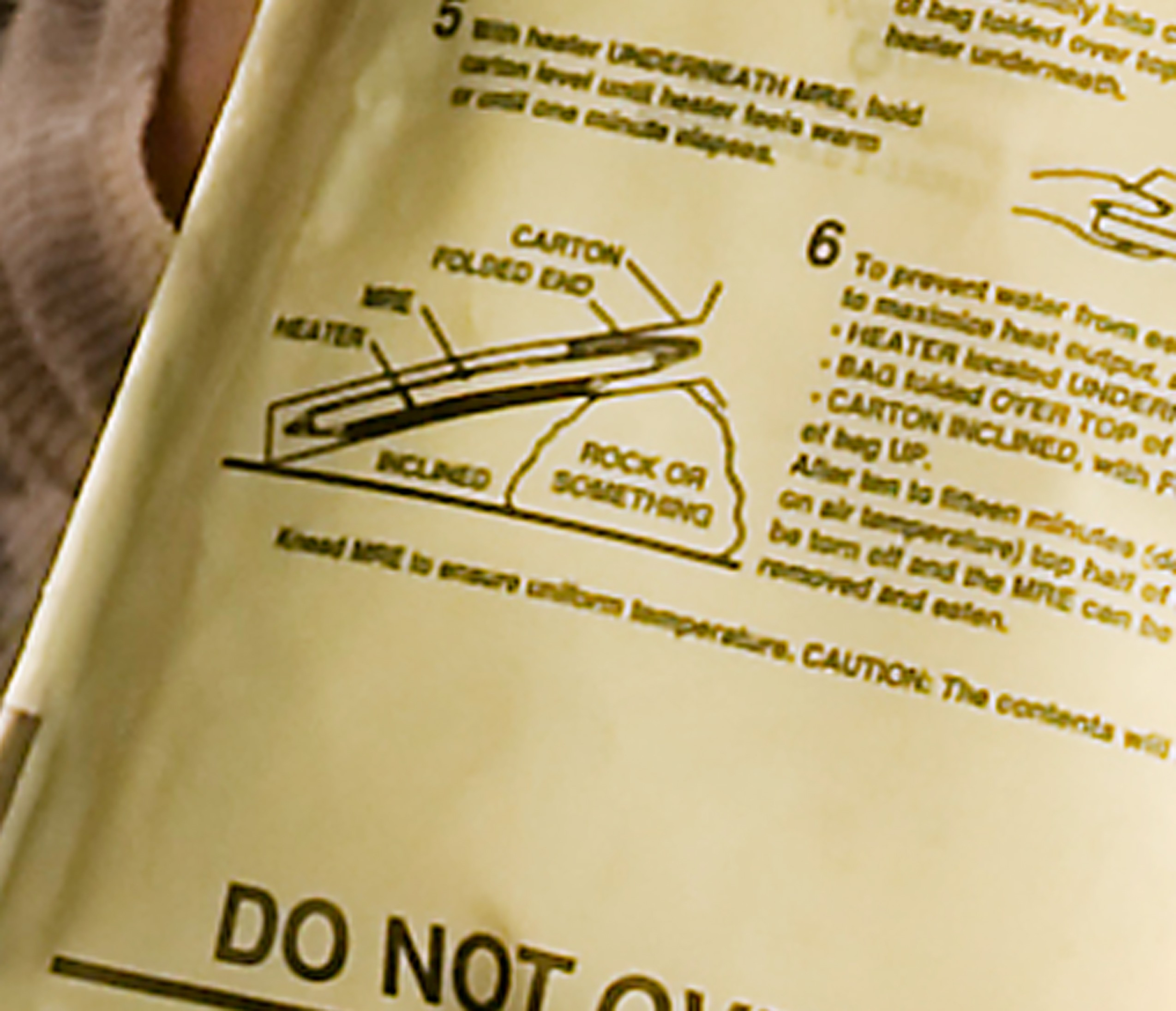
Somewhere in Army history, a person wrote instructions for heating lunch and decided the most useful piece of equipment was a “rock or something.” If you have ever opened a Meal, Ready-to-Eat, you probably know the little drawing: the heater and entrée lean against a vaguely rock-shaped object while the food warms up. It looks like the Army ran out of technical terms and just went with whatever was nearby.
That wording was deliberate. According to a U.S. Army account from its Natick combat-feeding team, the phrase began as a joke while the flameless ration heater’s directions were being designed. It survived onto the package and became one of the few lines of military instructions people actually remember. The funny part is that the rock has a real job.
Featured image: A close-up of the “rock or something” diagram on a flameless MRE heater. U.S. Army photo, published with the Army’s account of the heater’s origin. The image shows the package instructions, not a meal being heated in the field. U.S. military imagery does not imply Department of Defense endorsement.
Who put “rock or something” on the MRE heater?
The Army traced the story to the team that developed the flameless ration heater at Natick, Massachusetts, in the early 1990s. Food technologist Lauren Oleksyk recalled working on the instruction diagram with colleagues Bob Trottier and Don Pickard. They needed to show an object that would hold the heater at an angle. Pickard suggested a rock—or something else that would do the same job. The team put the casual wording in the drawing as a joke, and it stayed.
There is a reason the story sounds like something a soldier would make up. Official instructions usually do not invite you to improvise with an unidentified object. Yet that is exactly what someone eating outdoors may need to do. The package did not require a particular government-issued rock. It needed a stable prop. The label managed to be both practical and funny without a committee improving the joke out of existence.
Why does the MRE heater have to lean?
The prop is not decoration. A Defense Logistics Agency drawing of the heater instructions shows the food pouch above the heater, the bag folded over it, and the sleeve inclined with its folded end up. The drawing explains that this position helps keep water from escaping and gets more heat into the meal. The rock is simply the stand holding that angle. A boot, a box, or another stable object may serve the same purpose; follow the directions on the particular heater you have.
Inside the sleeve, a small amount of water starts a heat-producing reaction in the heater pad. The Army’s Natick account said its design could raise the temperature of an eight-ounce entrée by about 100 degrees Fahrenheit in roughly 10 minutes. Those are reported design figures, not a promise that every pouch on a freezing day will come out equally hot. The food itself is sealed in its own pouch; the heater warms it from outside.
That arrangement is clever in the unglamorous way a lot of good field gear is clever. It is light, packs with the meal, and does not require a stove or an open flame. You still need to handle a hot pouch carefully, but you do not need to carry a separate cooking kit just to turn a cold entrée into a warm one.
Before the heater, hot lunch needed more gear
The MRE replaced canned field rations in the early 1980s, according to the Army’s individual-rations history. A ready-to-eat meal was useful even cold, but “ready” did not necessarily mean pleasant. Before the flameless heater, soldiers could use trioxane fuel bars with a canteen cup and stand to warm an entrée. Oleksyk explained that those fuel bars could not be packed beside the food. If the fuel and meal did not arrive together, the hot part of hot lunch was out of luck.
The flameless heater changed that. The Defense Logistics Agency says heaters have been packed in MRE bags since the early 1990s; Army material dates the heater’s introduction to 1993. The sources differ slightly on the exact rollout date, but agree on the larger point: a soldier could heat the sealed entrée with a little water and the equipment inside the meal bag.
That may sound modest next to every big Army invention you have seen in a recruiting video. Ask someone who has eaten a cold meal after a long, wet day whether warm food is a minor upgrade. The same practical affection explains why people kept the tiny P-38 can opener long after its original ration job disappeared. Good field tools earn loyalty by working when nothing else is convenient.
Even Julia Child found “something”
The Army’s Natick story includes a guest who took the directions seriously: chef Julia Child. Oleksyk recalled Child trying the heater herself. There was no rock available, so she used the stem of a wine glass to prop it up. That is not a suggestion for field use; it is a wonderfully unlikely image from the Army’s account. A chef famous for teaching people to cook found herself following the same sketch printed on a soldier’s lunch.
It also gets at why the phrase stuck. A more polished label might have said “incline the heater assembly on a suitable support.” That would be accurate and instantly forgotten. “Rock or something” tells you what you need to do in ordinary language. It leaves room for the fact that your lunch break might happen beside a vehicle, in a training area, or anywhere else the Army decides the ground is your dining room.
Army food is full of small stories. The World War II D-ration chocolate bar has a stranger backstory than its wrapper suggests. The heater’s label belongs in that tradition: an ordinary object becomes a story people tell after the field exercise is over.
So yes, the Army really did print “rock or something” on a heater. The phrase came from the people designing its instructions, and the prop helps keep the heater at the angle the design requires. The joke is that the Army said it out loud. The useful part is that, for once, the directions sound exactly like the advice the person next to you would give.