
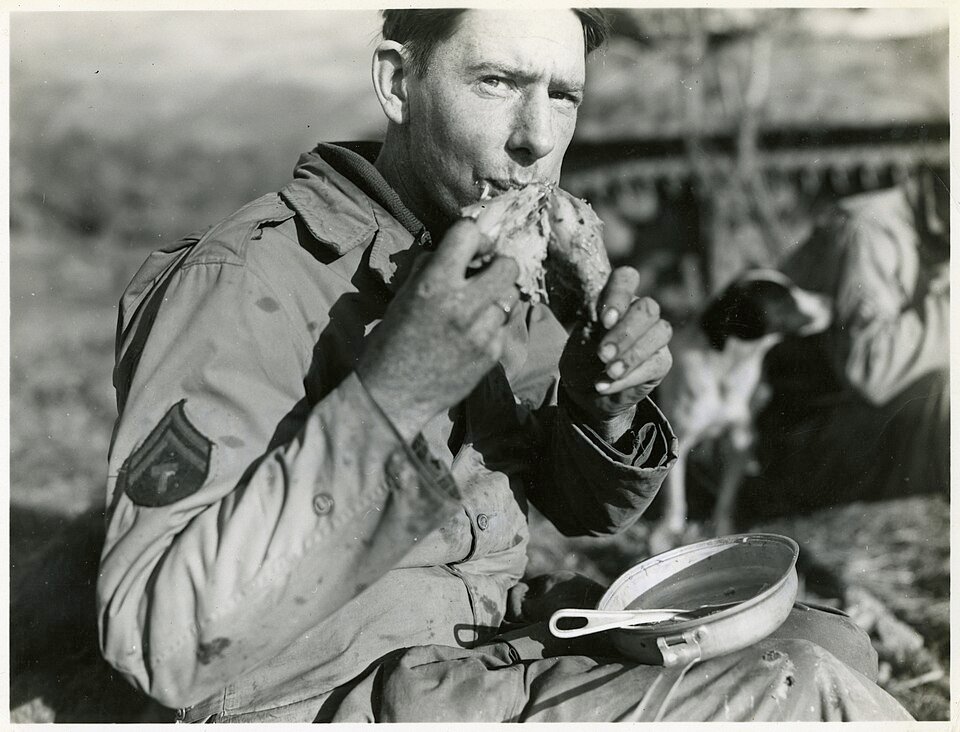
Claude Harwood spent Thanksgiving 1944 in a damaged building near the Hürtgen Forest. He was a soldier in the 1st Infantry Division, and his unit had just come out of the trees. After dark, a jeep delivered his holiday dinner: turkey between two slices of bread and a cup of half-warm coffee. Harwood later told Fort Riley Public Affairs that he ate over a newspaper so he could catch every crumb.
That sandwich had a remarkable supply chain behind it. The U.S. Army had moved 1,604 tons of turkey to continental Europe for Thanksgiving, according to its official Quartermaster Corps history. It was a huge effort to make one meal feel a little like home. For Harwood, it ended up looking more like a field-expedient lunch.
A holiday promise in the middle of a supply problem
By the fall of 1944, Allied forces were pushing east after the Normandy invasion. Supplying them was getting harder as the distance from the ports to the front grew. The Quartermaster Corps had already committed in September to a Thanksgiving turkey dinner for troops on the Continent. The official history says commanders worried that failing to deliver a widely publicized promise would hurt morale.
Turkey was an awkward choice for an Army fighting a war of movement. The Quartermaster history estimated a holiday serving at one and a half pounds, equal to three ordinary meat meals. Poultry also required refrigerated storage space equivalent to four and a half normal meat meals. That is a lot of cold space devoted to one day of chow.
The refrigerated ship Great Republic carried the 1,604 tons. By November 18, the Quartermaster Corps had distributed turkey along with apples, oranges, eggs, onions and cabbage. Refrigerated vans and even mobile bakery company trucks helped move the food. The challenge was not simply getting a ship across the ocean. Somebody still had to unload, chill, inspect, route and deliver the birds through a transport system already under pressure.
It is easy to picture a cheerful line of troops walking through a warm dining hall. That happened in some places. But the men at the front were spread across villages, roads and fighting positions. No one could put a carving station beside every foxhole.
The turkey did not land on every plate at the same time
The Army’s own account is honest about the result: some combat troops got their special ration one or two days late, and a few missed the turkey dinner for tactical reasons. That matters. The story is more interesting when the logistics feat and its limits are both in view. The mission was a broad success under difficult conditions, not a magical guarantee that every soldier enjoyed a hot meal on November 23.
Conditions also varied dramatically by unit. In northern Luxembourg, a National WWII Museum account describes trucks arriving with turkeys, cranberry jelly and potatoes. Soldiers prepared meals in field kitchens and ate from mess kits in tents and barns. Local families, many of whom had never seen an American Thanksgiving, watched the unusual celebration. Only weeks later, the Battle of the Bulge would shatter the relative quiet in that area.
Harwood’s position near the Hürtgen Forest was a different scene. He had the sandwich and coffee, appreciated both, and saved the crumbs. The following day, he was wounded when a bullet passed through his helmet and ear, he recalled in the Army interview. That detail gives the meal its scale: there was no long holiday pause, just a moment of comfort between dangerous days.
There is a home-front twist, too. An Army history of Thanksgiving says the War Food Administration restricted civilian turkey sales in fall 1944 until the Quartermaster Corps met its requirements. The same account says poultry production was high enough that the restriction was not ultimately needed in practice. So the neat claim that the Army simply “took all the turkeys” is a better headline than history.
Why commanders cared about one meal
Gen. George C. Marshall paid attention to the holiday dinner. The George C. Marshall Foundation preserves his 1943 correspondence about families writing to thank the War Department after hearing what their loved ones had eaten overseas. A dinner was never a substitute for safety or time at home. It was a signal that somebody remembered the people doing the fighting.
That signal is still familiar. At a small joint security station in Baghdad in 2009, Army reporting described commissioned officers and senior NCOs serving Thanksgiving dinner to soldiers who ran daily patrols from the camp. The tradition puts leaders behind the line for once. The cooks and food-service soldiers do the real heavy lifting, and everybody else gets a plate and perhaps a few minutes to feel less far away.
The 1944 operation also shows a side of military history that rarely makes the movie trailer. The ship, refrigerated trucks, port crews, inspectors and field kitchens all mattered to the soldier with the sandwich. If you have ever seen a holiday meal appear in an unlikely place, you know somebody worked hard to get it there. The Fort Huachuca story about the first McDonald’s drive-thru is another reminder that military life can leave fingerprints on the way America eats.
Harwood did not get a perfect Thanksgiving spread. He got turkey on bread, coffee that was not quite hot, and a newspaper to catch the crumbs. After an Atlantic crossing and a massive Army supply effort, that was the holiday reaching one soldier at the front. In his telling, it was enough to remember more than seventy years later.
Featured photo: U.S. Army Technician Fifth Grade William Fleming eats a Thanksgiving turkey leg near San Benedetto, Italy, on November 17, 1944. Photo by Schmidt, 3131st Signal Service Company, via the Signal Corps Archive on Wikimedia Commons (public domain).
