
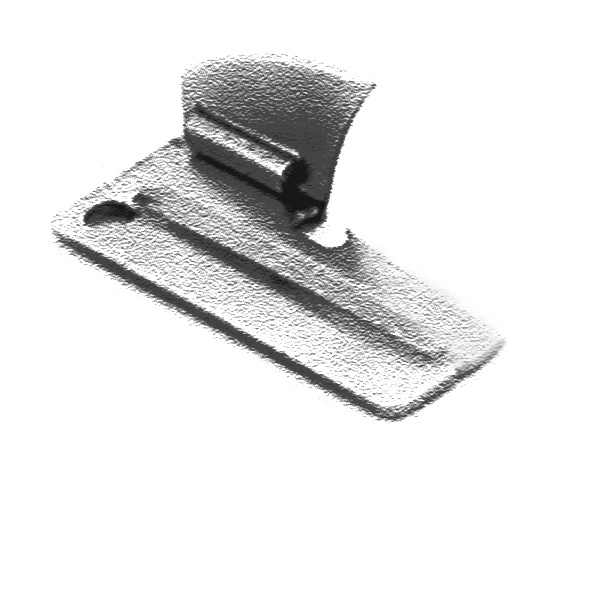
Featured photo: A P-38 folding can opener photographed for a 2017 U.S. Army Fort Lee story. Courtesy photo / DVIDS (public domain). The appearance of U.S. Department of War visual information does not imply or constitute Department of War endorsement.
Imagine getting to the end of a long day, finding a can of dinner in your field ration, and realizing the only thing standing between you and food is a piece of metal barely longer than your thumb. For generations of troops, that little piece of metal was the P-38 can opener.
It folded flat, fit on a dog-tag chain, and did one job with almost insulting simplicity. Then soldiers found plenty of other jobs for it. Years after canned rations gave way to MREs, some veterans still kept their P-38s. That is a lot of loyalty for something you could lose in a couch cushion.
The key to a canned dinner
The P-38 appeared with U.S. field rations during World War II. Its hinged cutting blade folded against a small metal body with a hole for a chain or key ring. Flip the blade out, catch the rim of a can, and work your way around it a puncture at a time. There was no pull tab to save you.
The Army’s Fort Lee account describes its use with K- and C-ration canned food; the Quartermaster Museum’s ration history documents the can openers in wartime ration packages. If the chow was sealed in metal, this tiny tool mattered more than its size suggested. A soldier with a can and no opener had a logistics problem at the worst possible scale: one hungry person.
In an Army feature built from veterans’ recollections, World War II veteran John Bandola said he met the P-38 in North Africa in 1943. He remembered using it for boots, fingernails, and screwdriver work as well as meals. He carried one on his keys through campaigns in Italy and kept it after the war. For him, the opener was a reminder of the people who served beside him, not a collectible gadget.
What does “P-38” mean? The story gets messy
You may have heard that the name comes from the 38 punctures needed to open a ration can, or that the little opener was as quick as the P-38 Lightning fighter. One Army article repeats those explanations. But a later Fort Lee history says the name’s origin is unknown and points out that the tool is roughly 38 millimeters long. Treat the popular explanations as possibilities, not a solved case.
Its origin story deserves the same care. Army accounts credit the World War II ration version to the Subsistence Research Laboratory in 1942. Yet retired Lt. Col. Charles Moody traced similar folding-opener designs to a 1913 patent and a 1924 magazine illustration. The Army may have produced a brilliantly useful version for its rations; it did not invent the basic idea of a folding can opener from nothing.
None of that makes the P-38 less impressive. If anything, it is a familiar military lesson: the thing that earns its place in a kit is the thing that works when somebody actually needs it.
“John Wayne” and the unofficial tool list
The opener picked up a nickname, too. Army and Navy accounts record troops calling it the “John Wayne,” though the precise reason for that nickname is not settled in those sources. What is clear is that it traveled far beyond the chow can. Veterans interviewed by the Army described using it as a small screwdriver, cleaner, marking tool, and emergency car-repair helper. The chain hole meant it could stay with them instead of vanishing into a footlocker.
That versatility can sound like the kind of claim people make about every piece of issued gear. The difference here is the testimony. In the Army’s collection of firsthand accounts, retired Col. Paul Baerman remembered his platoon hanging P-38s from a makeshift Christmas tree in Vietnam in 1969. Yes, the Army found a way to make a can opener into a holiday ornament. He associated the tool with being back among his soldiers for the holiday.
Another veteran in the same account, Ted Paquet, described meeting the P-38 while serving aboard a ship off Vietnam. Later, when his car broke down, he and his brother both reached for P-38s on their key rings. It is a funny image, but it tells you why so many people kept one: it weighed almost nothing and might be useful when the right tool was somewhere else.
A great tool still had limits
Nostalgia can turn an old item into a superhero. A P-38 did not open itself, and cold fingers could make its tiny blade miserable to use. David Marshall, a World War II veteran of the 84th Infantry Division, recalled in a 2014 Army Reserve interview that his hands were so frozen during the Battle of the Bulge he could not use it on a ration can. His memory is a sharp reminder that a clever design still depends on the person holding it and the conditions around them.
The tool also lost its original mission. As canned C-rations were replaced by meals packed without those metal tins, troops no longer needed a dedicated opener with each ration. The Fort Lee history places its disappearance from routine ration use around the arrival of MREs in the early 1980s. Surplus stores and key rings kept it alive long after its supply-chain job faded.
Why a thumb-size opener outlasted the can
Ask an older veteran about the P-38 and you may get a ration story, an improvised repair story, or a story about the person who handed one over. That last part is why the tiny opener became a keepsake. Bandola told the Army he intended to pass his along to his son and grandson. The metal was cheap. What it carried was not.
Most of us have a piece of kit like that: something ordinary that suddenly brings back a whole place and a whole group of people. The woobie gets that reaction from a later generation of soldiers. The P-38 earned it one can at a time. If you still have one on your keys, there is probably a reason. And if you know a veteran who does, ask them where it came from. The answer may be better than the official history.