
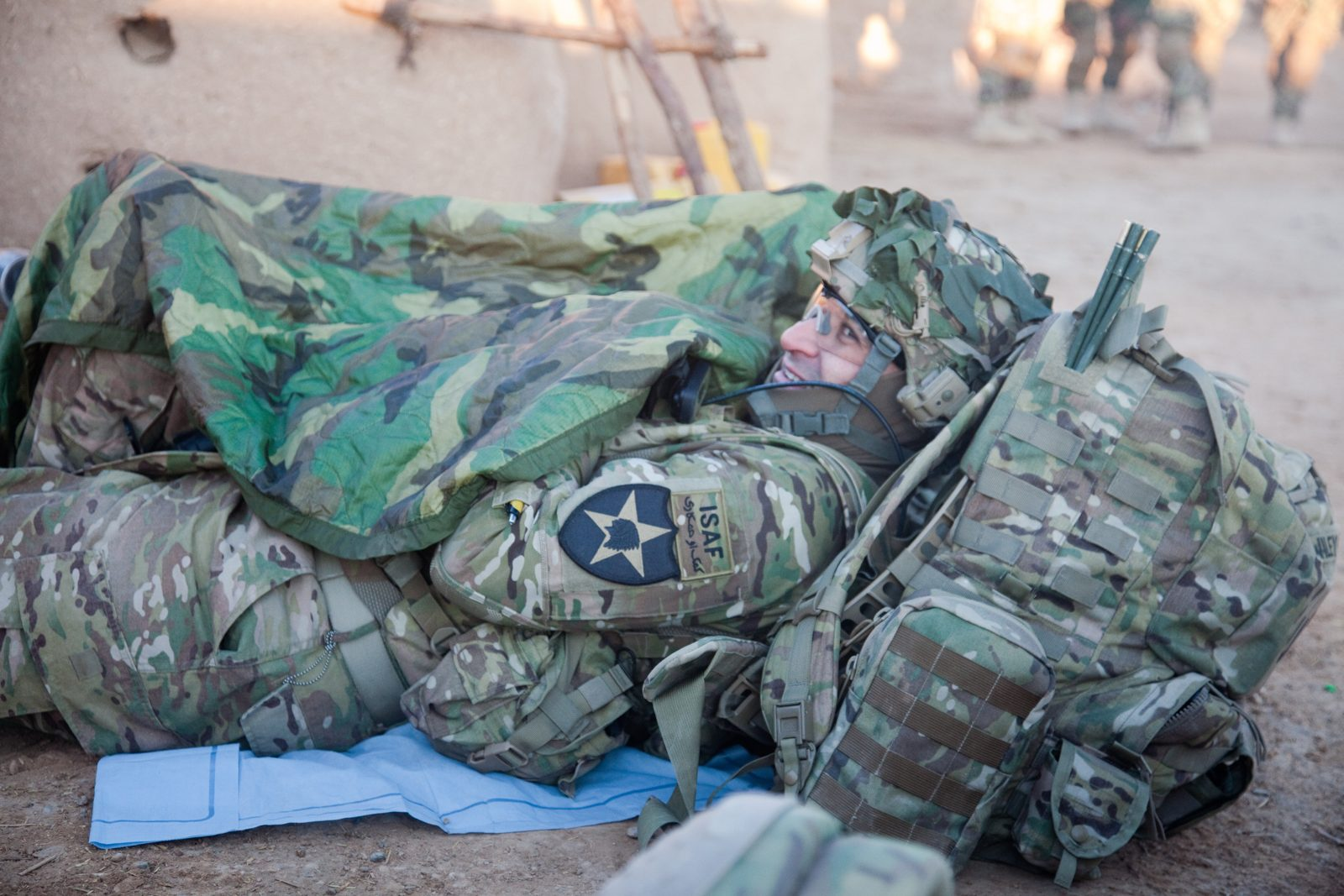
Featured photo: U.S. Army Capt. Kevin Wiley rests under a poncho liner during Operation Regular Flint in Afghanistan, Jan. 16, 2012. U.S. Army photo by Spc. Kristina Truluck / DVIDS.
The Army has issued soldiers a lot of gear over the years. Some of it is useful. Some of it makes you wonder whether the person who designed it ever met a human with shoulders. Then there is the poncho liner: a thin, quilted rectangle that inspires a level of loyalty most commanders would love to have.
Call it a poncho liner on a supply record. Call it a woobie around veterans and watch the conversation change. People who cannot remember where they put a pair of gloves can tell you exactly what pattern their old woobie had and where they took it. That affection is a real part of military culture, even if the blanket itself looks about as glamorous as a spare shower curtain.
What is a woobie, exactly?
The woobie is a lightweight insulated liner made to tie into a wet-weather poncho. Its cords attach to the poncho’s grommets, turning the pair into a simple cover for cold, wet conditions. Many soldiers found a more direct use: wrap up in the liner by itself whenever there was a chance to rest. Coffee or Die’s history of the poncho liner explains both its intended function and its much more popular life as a field blanket.
There is even an official-paperwork joke hiding in plain sight. A recent Army Jungle Operations Training Course packing list calls it “Poncho Liner (Woobie) OR Hot Weather Sleeping Bag.” Once a nickname makes it onto a packing list, the argument over whether it is a “real” Army term is pretty much over.
It is not magic, and it is not a full winter sleeping system. It is portable, flexible, and pleasant to have when the day has been long and the accommodations are whatever patch of ground you can claim. Field gear does not have to solve every problem to become the item you reach for first.
A Vietnam-era solution that outlived the war
The poncho liner became associated with U.S. troops in Vietnam, where a bulky wool blanket was a poor fit for the weight and dampness of field life. Contemporary reporting traces the Army’s early issue of the liner to Special Forces in 1963, with its use spreading more widely as troops recognized the advantage of something light and quick to dry. That history is summarized by Coffee or Die and Military.com.
The original idea was practical rather than sentimental. A soldier needed warmth without lugging a traditional blanket through a wet environment. The poncho liner answered that problem well enough that its job description kept expanding. In the field, it could be bedding, a wrap, or an extra layer between a tired person and the elements. The official name described how to attach it. Soldiers described what they actually did with it.
That is one reason the woobie lasted through big changes in uniforms and equipment. If you enjoy comparing the Army across generations, our look at how the Army changed from 1996 to 2026 covers plenty of items that did not inspire this kind of affection. The humble liner kept showing up because simple and useful ages pretty well.
The name is a mystery; the affection is not
Where did “woobie” come from? The honest answer is that nobody has produced a definitive origin. One popular theory points to the child’s security blanket called a woobie in the 1983 movie Mr. Mom. Other explanations circulate, and Military.com describes the name’s origins as murky. Treat the movie connection as a theory, not a documented naming order from the Pentagon.
The nickname stuck because it fits. A woobie has a job beyond its technical purpose: it is a familiar thing in an unfamiliar place. That can sound childish until you remember how little comfort a soldier gets to choose during a field exercise or deployment. Nobody is claiming a blanket fixes the hard parts. But having one reliable piece of kit at the end of a miserable day is not a small thing either.
Anyone who has spent time in Army barracks or slept in the field knows that “comfortable” is often a relative term. If your options are cold ground and cold ground plus woobie, the second option wins by a landslide.
More than a blanket
A DVIDS photograph from Afghanistan catches the appeal without any advertising copy: Capt. Kevin Wiley of the 5th Battalion, 20th Infantry Regiment pulled a poncho liner over himself during a break in Operation Regular Flint on Jan. 16, 2012. His gear is piled around him. The liner is doing the unglamorous but important work of making a few minutes of rest better.
Another DVIDS image from survival training in Djibouti shows a different job. In October 2018, Spc. Killian Tooke used a poncho liner to make shade while practicing shelter construction. It is a useful reminder that a large piece of fabric with ties can earn its place in a ruck in more than one way.

Still, common sense matters. A liner is not a waterproof shelter by itself, and improvisation should fit the weather and the training situation. The great thing about the woobie is not that it replaces every other item on the packing list. It is that it keeps finding little jobs worth doing.
Why soldiers keep talking about it
Part of the answer is utility. Part is memory. Field time has a way of making small comforts feel enormous. The same rectangle may remind one veteran of an Afghanistan patrol break, another of a miserable training night, and someone else of being taught what to pack before their first exercise. It is a shared reference point across years, units, and branches without requiring everyone to have had the same experience.
It also gives veterans a rare gear argument that is mostly fun. People can debate which camouflage pattern looked best, whether the older ones felt better, or whether they still keep one at home. Nobody needs a briefing slide to understand the appeal. If you are heading into the field for the first time, the basic-training phase guide covers the bigger adjustment; the woobie is one small example of how soldiers learn to make a hard environment more livable.
There are certainly more advanced things in a soldier’s kit. Few get discussed with the same grin. The Army designed a liner for a poncho. Soldiers turned it into the woobie, and the nickname may be the best performance review any piece of equipment has ever received.
The appearance of U.S. Department of War (DoW) visual information does not imply or constitute DoW endorsement.