
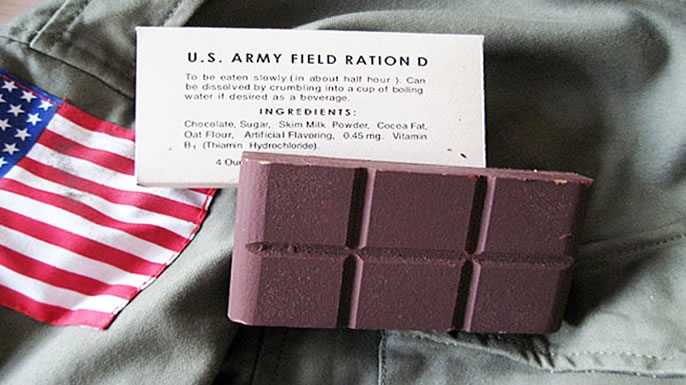
Imagine telling Hershey to make a chocolate bar soldiers wouldn’t want to eat. That sounds like a mess-hall joke, but it was a real Army requirement. The result was Field Ration D: a compact World War II emergency bar built to survive heat and deliver calories, even if nobody mistook it for a candy-aisle treat. The story gets stranger when you reach the photograph of D bars being packed into artillery shells for cut-off infantry in France.
Featured image: U.S. Army Field Ration D chocolate bar. U.S. Army Center of Military History, via Wikimedia Commons (public domain).

Why would the Army want disappointing chocolate?
In April 1937, Army Quartermaster officer Capt. Paul Logan met with Hershey executives and chief chemist Sam Hinkle about an emergency ration. According to the Hershey Community Archives, Logan wanted a four-ounce bar that resisted heat, carried substantial food energy, and tasted only “a little better than a boiled potato.” A normal Hershey bar would melt in a pocket and might disappear long before an actual emergency. The point was to keep this bar available when a soldier really needed it.
That distinction matters. The Army was not trying to punish troops with bad dessert. It was designing a reserve ration, not a morale snack. The U.S. Army Quartermaster Museum’s ration history describes the bar as an emergency or stopgap food. It also notes the problem that followed when the D ration was used as ordinary combat food: soldiers disliked it, and the Army eventually leaned on other rations for regular meals.
A bar built like a piece of field equipment
Hinkle reduced the sugar and used chocolate liquor, skim milk powder, cocoa butter, oat flour, and flavoring. The result packed about 600 calories into four ounces. Three bars made a roughly 1,800-calorie emergency ration. Hershey’s own history says the mixture was so thick it had to be pressed into molds instead of poured like ordinary chocolate. For an early order of 90,000 bars in 1937, workers weighed, kneaded, and pressed each portion by hand.
Think about that production line for a second. A chocolate company had to build a process around chocolate that refused to behave like chocolate. The bar’s hardness was useful in a hot climate, but it also helped earn its reputation as something closer to edible survival gear than a reward at the end of a long day. The Smithsonian’s account describes how difficult it was to bite and notes that soldiers could let it dissolve in water.
Field tests sent the bars to places including the Philippines, Hawaii, Panama, and the Texas border. Hershey says some even went to Antarctica with Admiral Byrd’s 1939 expedition. By the time America entered World War II, the product had moved well beyond an odd experiment in a candy factory. The Army had an emergency food that could travel where conventional chocolate struggled.
Chocolate by artillery shell?
One of the best pieces of evidence that the D bar was treated as practical field supply is a U.S. Army Signal Corps photograph preserved through the National Archives. Its caption, dated October 29, 1944, says D-ration chocolate and Halazone water-purification tablets were being packed into 105mm howitzer shells intended for an infantry battalion cut off by German forces near Belmont, France.

It is a remarkable wartime image: emergency calories and water treatment packaged for delivery by a weapon normally associated with the exact opposite of care packages. The caption documents the packing and the intended delivery. It does not tell us how many shells were fired or whether the supplies reached the battalion, so there is no reason to invent a tidy ending. The preparation alone says plenty about how urgently troops needed portable food and clean water.
Then came the chocolate soldiers actually wanted
The emergency bar solved a real problem, but the Army also wanted a heat-resistant chocolate that people might enjoy eating. In 1943, according to the Hershey archives, it asked for an improved-flavor confection. Hershey developed the Tropical Chocolate Bar in smaller one- and two-ounce sizes. This was a different assignment: give troops something durable and more appealing.
The distinction between the two bars gets blurred in retellings. Field Ration D was the dense emergency ration; the Tropical Bar was the later, more palatable heat-resistant chocolate. Hershey reports that the Tropical Bar eventually surpassed the D bar in production tonnage and even traveled with Apollo 15 astronauts in 1971. The Quartermaster Museum says misuse of the D bar as combat food helped make it unpopular, and by 1945 it had been classified as limited-standard. That is a better explanation than the easy joke that the Army simply forgot what good chocolate tasted like.
The soldier’s-eye lesson
There is something very Army about a food item that meets every requirement on paper and still leaves people looking for a trade. Four ounces, 600 calories, heat resistance, pocket-sized portability: all useful. A pleasant snack? That was somebody else’s requisition. The D bar was a solution to the worst kind of day, not a promise of a good one.
That is why the story is worth remembering. It shows the gap between emergency survival and daily morale, a gap anyone who has opened a field ration can understand. If old ration gear is your thing, the tiny P-38 can opener had a much longer sentimental afterlife. And for another strange example of World War II problem-solving, see how the Ghost Army used deception as a weapon. This chocolate bar’s assignment was simpler: stay uneaten until the moment eating it really mattered.