
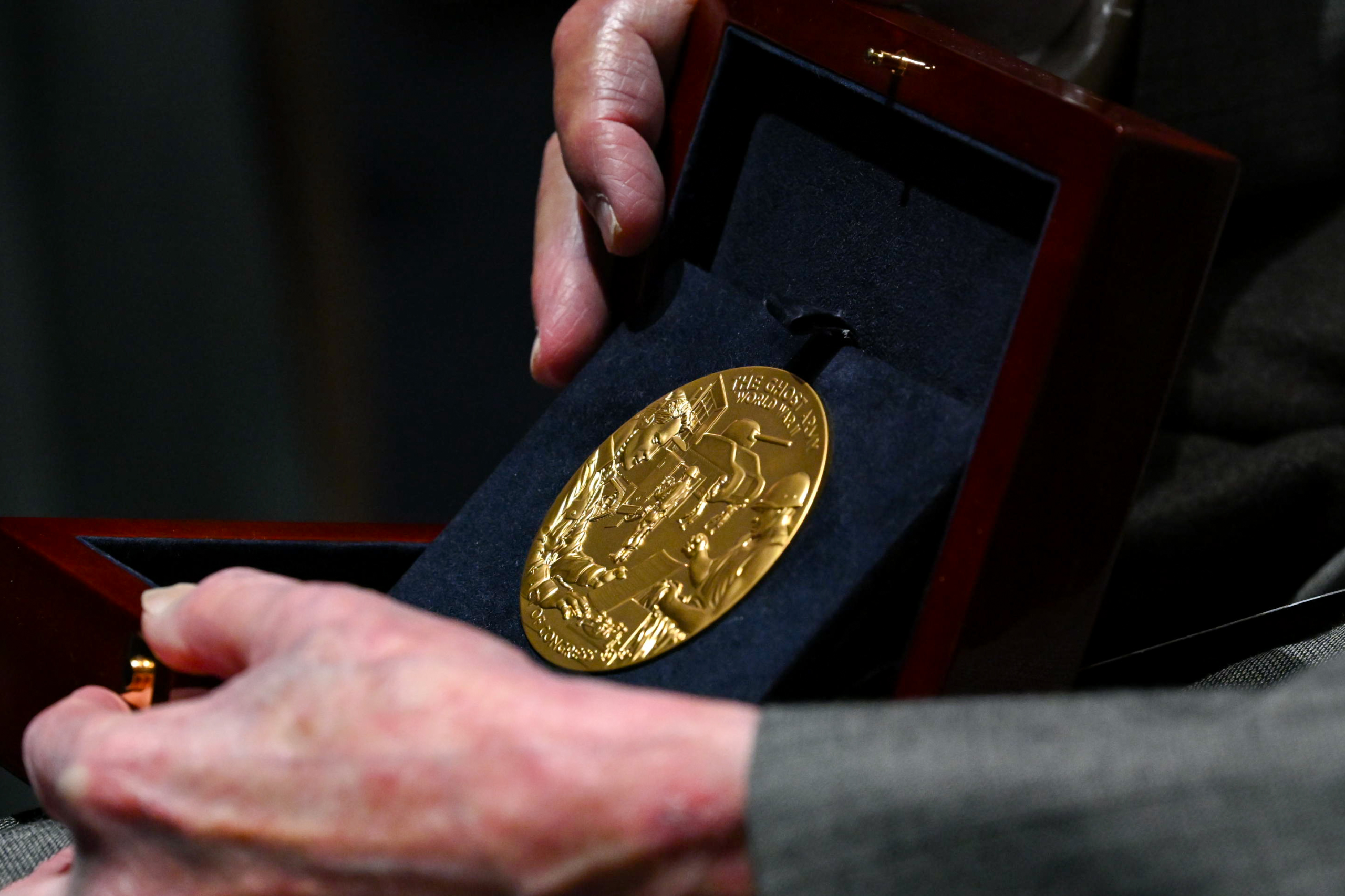
Featured photo: A Ghost Army veteran holds the Congressional Gold Medal at the U.S. Capitol, March 21, 2024. U.S. Army photo by Sgt. David Resnick / DVIDS.
Imagine getting assigned to a tank unit and discovering that four guys can pick up the tank. That sounds like the setup for a supply-room prank. During World War II, it was part of an actual American combat deception mission.
The Ghost Army used inflatable equipment, recorded battlefield noise, misleading radio traffic, and soldiers playing convincing roles to make German forces see an American army where the real one wasn’t. The tanks were fake. The soldiers taking the risk were very real.
With October here, this is a ghost story worth knowing: no haunted barracks, just a bunch of Americans turning creativity into a battlefield weapon.
What was the Ghost Army?
The name is closely associated with the Army’s 23rd Headquarters Special Troops, a roughly 1,100-man unit activated on January 20, 1944. Its job was to mislead the enemy about American strength and location. The broader Ghost Army story also includes the 3133rd Signal Service Company Special, which operated in Italy. These were real military units, not imaginary names on a map. Fort Drum’s historical account explains the mission; AP’s reporting on their recognition distinguishes the two organizations.
The 23rd brought together different skills. Its camouflage engineers included artists, while other elements handled radio deception, sound, security, and the hard work of building a believable scene. According to the unit’s official history, the sonic specialists of the 3132nd Signal Service Company Special joined the 23rd in France in August 1944.
Think of it as a production crew with an extremely unforgiving audience. If the enemy spotted the trick, nobody could simply stop the show and offer a refund.
A tank that needed air instead of armor
The inflatable Sherman is the part everybody remembers, for obvious reasons. A tank-shaped balloon is inherently funny until you remember somebody had to set it up close enough to a war to make it useful.
The official history describes the rubber M4s as weighing 93 pounds when inflated. It also records how difficult it was for officers accustomed to real tanks to adjust to commanding dummies. That might be the most understandable workplace adjustment in Army history.
But the clever part wasn’t owning a fake tank. It was making the whole scene believable. A dummy formation had to support the story the enemy was expected to accept. The visual props, activity, and other signals needed to agree. Otherwise, all you had was a very expensive lawn ornament.
As an Army historical presentation at Fort Leonard Wood emphasized, the important ingredient was the soldiers’ ability to improvise. Many camouflage specialists had been recruited from art schools. Suddenly, being the guy who could make something look right had operational value.
The soundtrack was part of the mission

A silent concentration of vehicles could create an awkward question. The Ghost Army had an answer: make the enemy hear movement, too.
At Pine Camp, now Fort Drum, soldiers trained with sound technology developed at Bell Labs. Recordings could suggest vehicles, personnel, and construction. This required more than turning a speaker up until everyone complained.
Fort Drum’s account describes crews considering terrain, distance, and weather, even using a mobile weather station to understand how sound would travel. Separate sound tracks and speakers helped create a convincing impression. Somewhere in this operation, getting the audio levels right was a serious military responsibility.
Add deceptive radio traffic and impersonation, and the inflatable equipment becomes easier to understand. The objective was to give the enemy several apparently supporting clues, all pointing toward the same wrong conclusion.
The big bluff on the Rhine
Operation Viersen shows why this mattered. During March 18–24, 1945, the 23rd helped Ninth Army conceal the location and timing of its Rhine crossing preparations.
The official account of Viersen explains that the unit simulated the 30th and 79th Infantry Divisions in one corps’ area while the actual divisions assembled elsewhere. Real units supported the deception, and the 23rd’s performance fit into a much larger Army plan.
That distinction matters. This wasn’t a few artists independently winning a campaign with balloons. It was a coordinated effort to make real combat power harder to locate, with the deception troops helping sell the wrong picture.
Nor did every earlier attempt work perfectly. The unit’s own wartime history is candid about uncertain results and lessons learned during Operation Elephant. The honest version is more interesting than the legend: soldiers tried something unfamiliar, found weaknesses, and improved it under wartime pressure.
The secret outlasted the war
For decades, the full story stayed out of public view. Captain Fred Fox’s official history, written in September 1945, was declassified in 1996, according to the Ghost Army Legacy Project’s archive introduction.
On March 21, 2024, Congress presented a Congressional Gold Medal honoring the 23rd and the 3133rd. Three surviving veterans attended the ceremony, a milestone documented by the Ghost Army Legacy Project. Recognition finally caught up with work that had depended on secrecy.
The appeal of this story goes beyond the rubber tanks. Soldiers are used to being told to make things work. These men made an entire false picture work, combining talents that don’t always fit the usual war-movie casting call.
For another reminder that military stories take unexpected turns, read about service-academy football players who reached the NFL. Or compare a more familiar Army with our look at how the Army changed from 1996 to 2026.
And the next time someone dismisses the creative guy in the platoon, remember: the Army once needed people who could make a tank look convincing without making it a tank.
The appearance of U.S. Department of War (DoW) visual information does not imply or constitute DoW endorsement.