
The U.S. Army once put camels on the payroll. This was not a mascot gag or a fever dream from a particularly long staff meeting. In the 1850s, the Army imported camels to haul supplies across the Southwest, tested them against mules and wagons, and found that the animals could do the job. Then the whole experiment vanished. The interesting question is not whether camels worked. It is why a working idea couldn’t survive the Army around it.
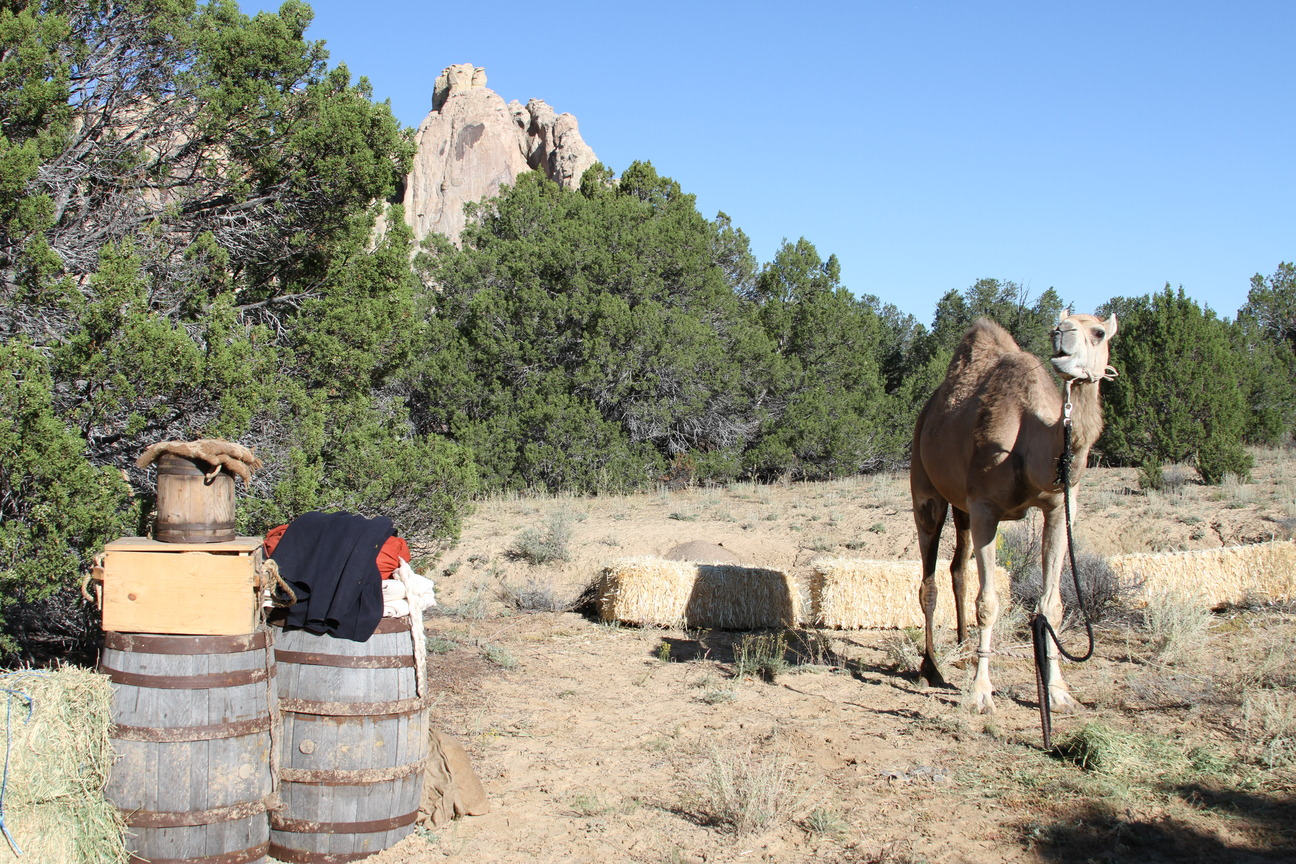
Featured image: A camel at a modern Camel Corps commemoration at El Morro National Monument, New Mexico, in 2014. This is a reenactment scene, not an 1850s photograph. NPS photo by Wendy Parrish, National Park Service (public domain).
Why did the Army need camels?
After the Mexican-American War, U.S. forces faced enormous distances and dry country in the Southwest. Horses, mules, and wagons needed water, feed, and workable roads. Maj. Henry C. Wayne argued that camels might carry supplies where the usual Army transportation struggled. Secretary of War Jefferson Davis backed the idea, and Congress approved $30,000 in 1855 to buy and test them. Yes, that Jefferson Davis, who later led the Confederacy. History rarely keeps its characters in neat categories.
The project was an Army-Navy team-up. Wayne selected animals overseas while Navy Lt. David Dixon Porter prepared the USS Supply to bring them home. According to the Army Transportation Corps’ history, Porter built a 60-foot camel barn on deck, arranged ventilation, and made a loading system. One particularly huge Bactrian camel forced a further deck modification so its humps could fit. If your equipment plan requires cutting a new opening in a ship for the passenger’s humps, you know this is no ordinary procurement trip.
The first shipment brought 33 camels to Texas in May 1856, plus a calf born during the voyage. Porter made a second trip for more. Sources count the herd differently at different points because births and deaths changed the number, so the useful fact is that the Army built a real test herd at Camp Verde, Texas. It was not one lonely camel posing for a sketch.
The camels did the job
At Camp Verde, Wayne ran practical hauling trials. In one demonstration reported in the Army’s historical account, a camel rose with four bales of hay weighing 1,236 pounds and walked away while onlookers doubted it could even stand. That is one documented test, not a promise that every camel could carry that load all day. Wayne also compared camels with mule wagons on a supply trip and reported that six camels moved a comparable load over the same route much faster.
The bigger test came in 1857. Explorer Edward Beale took 25 camels on a wagon-road survey through the Southwest alongside mules and other animals. His first impression was not glowing: the new arrivals initially struggled to keep up. As they adjusted, his journal became increasingly enthusiastic about their sure footing, heavy loads, and tolerance for rough travel. The National Park Service notes that the expedition passed El Morro in New Mexico; Beale and others left inscriptions still connected to the story today.
One dry stretch showed why the experiment mattered. As the expedition’s mules desperately sought water, Beale observed the camels calmly browsing. The Army Transportation Corps account preserves his description of that contrast. This was precisely the problem the Army had paid to investigate: moving supplies through country where the normal animals and their support system could become the limiting factor.
By December 1857, camels entering Los Angeles were unusual enough for a newspaper to announce their arrival. That NPS account is a useful reminder that the camel trains were visible, public events, not an obscure proposal that never left a desk.
So why didn’t the Army keep them?
Being good at carrying things did not make the animals popular. Troops had to learn unfamiliar handling and care. The Army’s longer history describes objections to their smell, stubbornness, bites, and an unpleasant ride; horses and mules could react badly to them too. The camels were much more convincing as pack animals than as a replacement for cavalry horses. A useful tool can still be miserable to live with if the people using it never buy in.
Then the Civil War pulled attention, troops, money, and leadership elsewhere. Camp Verde and its camels fell into Confederate hands. Other animals remained in California, but the wartime Army had different priorities. The Army’s 2016 history also points out a political complication: Davis and Wayne, two major advocates, sided with the Confederacy. That does not prove politics alone killed the program. It does show why its champions were not well positioned to sell it to the Union Army.
The Army sold the California herd during the war and the remaining Texas animals in 1866. Some went to private owners; others escaped or were released. Later camel-sighting reports are part of the story, but a reported sighting is not proof of every colorful desert legend that followed. The firmer conclusion, supported by the Army and NPS histories, is that the experiment ended despite successful transport tests.
The most Army ending imaginable
It is tempting to file the Camel Corps under “weird military ideas that failed.” That misses the better story. The animals could haul heavy loads, travel tough routes, and spare scarce water. The larger program could not overcome unfamiliar training demands, an unimpressed workforce, and a country headed into war. Both statements can be true: the camels were useful, and the Camel Corps was not sustainable in the Army that had to operate it.
That tension probably sounds familiar to anyone who has seen a promising field idea collide with the rest of the system. The next time somebody pitches an unlikely fix, the right question might be less “Will it work?” and more “Will we actually use it?” If you like the Army’s less predictable history, the Ghost Army’s inflatable tanks took another strange idea into the field. For a more familiar piece of Army kit that soldiers genuinely kept, there is also the P-38 can opener. The camels earned their place in that company, even if their Army careers ended at auction.