
If you’ve skied Vail’s Riva Ridge, you’ve crossed a battlefield name without leaving Colorado. The run honors an Italian ridge that U.S. Army mountain troops climbed in the dark during World War II. Some came home and helped turn Colorado skiing into the industry people know today. That beats “somebody found a hill and installed a chairlift.”
The 10th Mountain Division’s story has two mountains in it: one where soldiers trained, one where they fought. Then came a third act in Aspen and Vail. Skiing existed in Colorado before the Army showed up. What the veterans brought back was expertise, ambition, and a network of people who knew what a mountain could demand.
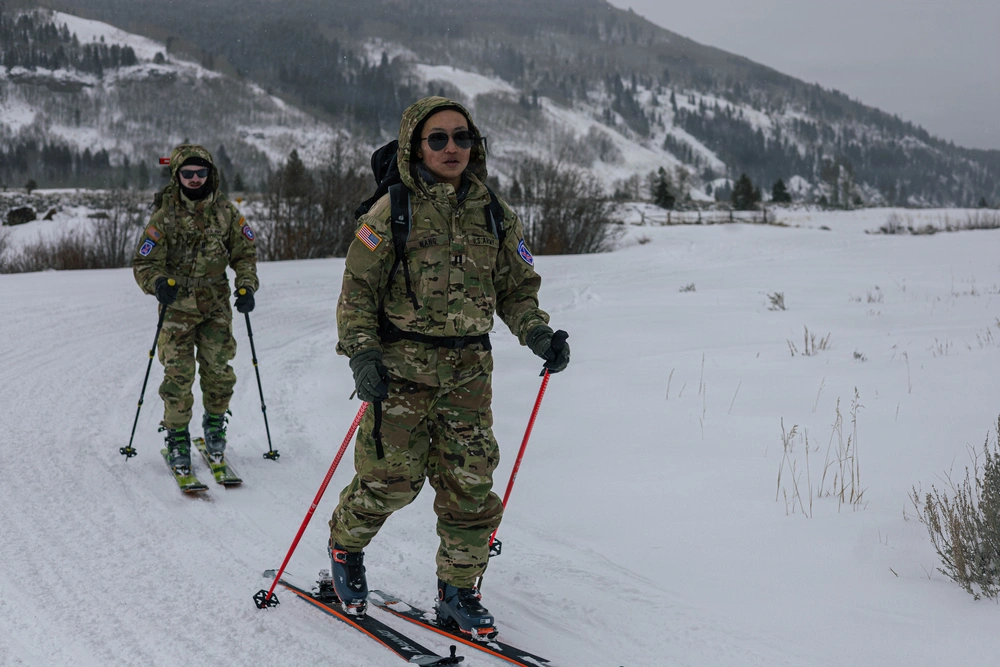
Featured image: Two present-day 10th Mountain Division soldiers ski at Camp Hale, Colorado, during Hale to Vail training on February 19, 2026. This is not a World War II photograph. U.S. Army photo by Sgt. Mariah Aguilar / DVIDS (public domain). The appearance of U.S. military visual information does not imply or constitute Department of Defense endorsement.
The Army builds a camp in ski country
Before America entered World War II, National Ski Patrol founder Charles “Minnie” Dole pushed the War Department to prepare troops for mountain warfare. According to the Army Corps of Engineers’ Camp Hale history, he had watched Finland’s ski troops resist a much larger Soviet force and argued that American soldiers needed similar skills. The Army built Camp Hale near Leadville, Colorado, in 1942. At roughly 9,200 feet, it was no gentle introduction to winter.
The future 10th Mountain Division trained there in skiing, climbing, snowshoeing, survival, and hauling gear through thin air and brutal cold. Some arrived as accomplished skiers; others had never strapped on skis. This was no recreational club with rifles. The Army needed troops who could move and fight on terrain that could defeat a formation before an enemy fired.
One exercise makes the point. In 1944, a group attempted the Trooper Traverse, a four-day, roughly 60-mile ski journey from the Leadville area to Aspen. Route-finding and avalanche danger were part of the challenge. Picture being told your field problem is to cross the mountains to another town with Army gear, then remember somebody called this “skiing.”
The ridge they climbed, not skied, in Italy
Training led to a far less playful assignment. On the night of February 18, 1945, soldiers of the 86th Mountain Infantry climbed Riva Ridge in the Italian Apennines to get around German defenses protecting nearby Mount Belvedere. The Army’s account dates the assault to that night and the Belvedere attack to the following night. They were not skiing downhill into combat. They were moving up icy, steep ground under a mission that demanded the climbing skills they had practiced in Colorado.
The surprise worked, but that should not make it sound easy or bloodless. A contemporaneous account by 10th Mountain soldier George Morrison Jr., preserved by Fort Drum, describes the preparation, the climb, and the exhaustion and losses afterward. The victory helped open the way for the Allied advance, while the division paid heavily through its campaign in Italy. A ski-resort story has to make room for the men who did not get to see the postwar mountains.
How Aspen got a mountain veteran back
Aspen was already skiing before the 10th Mountain Division trained nearby. The Aspen Historical Society’s timeline records a ski club and tow in the 1930s and national races in 1941. The veterans helped push an existing ski town into a new era.
One of the central figures was Friedl Pfeifer, an Austrian-born skier who had fled the Nazi regime and later served in the 10th Mountain Division. During wartime reconnaissance in 1943, he came to know Aspen. After the war he returned, directed the Aspen Ski School beginning in 1945, and worked with Walter and Elizabeth Paepcke as the Aspen Skiing Corporation formed in 1946. The historical society also credits him with opening Buttermilk Mountain in 1958. That is quite a second act for a soldier whose mountain skills had been needed for war.
Pfeifer was not working alone. The Aspen Historical Society identifies fellow 10th Mountain veterans John Litchfield and Percy Rideout as instructors in the early ski school. It was a community of people who knew one another through training and shared mountain work, now teaching civilians instead of preparing soldiers to cross a front line.
And Vail kept the battlefield name
Vail’s link is Pete Seibert, another 10th Mountain veteran. The Army Corps of Engineers names him as a founder of the ski resort. Vail’s Founder’s Day history describes Seibert and Earl Eaton climbing an unnamed mountain on March 19, 1957, then looking out across its back bowls. The resort opened in December 1962, after years of building.
They left an unusually direct military marker on the mountain. Vail’s own resort guide says the Riva Ridge trail was named for the Italian battlefield. Most ski-run names sound like somebody’s favorite animal or a joke that survived a planning meeting. This one points to a night when American soldiers climbed into a fight. Knowing that changes the feel of the sign.
The legacy is still on the mountain
The connection has not been left entirely to plaques. The division and National Ski Patrol have returned to Colorado for the Hale to Vail Traverse, a demanding ski event that links the old training ground with Vail. A 2024 Army account describes soldiers practicing avalanche response and mountaineering before the trek. The photo above shows modern soldiers training at Camp Hale for the same commemorative event in 2026. They are honoring the route, not reenacting a specific wartime moment.
So, did the 10th Mountain Division “build the American ski industry”? That is too big a claim for one unit. Ski clubs, local residents, investors, and workers existed before and after the war. The stronger, documented story is more interesting anyway: Army ski troops trained in Colorado, climbed into a hard fight in Italy, and then veterans such as Pfeifer and Seibert helped shape two famous mountain communities. That is a rare case where the road from an Army field problem leads straight to a ski-lift line.
If you like the Army’s less expected history, the Ghost Army’s fake tanks show a very different kind of World War II improvisation. And the Camel Corps is another reminder that the Army has tried stranger transportation ideas than skis. The mountain troops’ idea lasted well beyond the war—every time someone sees “Riva Ridge” on a trail map, part of their story is still there.