
For seven years, the federal government marked Veterans Day in October. Yes, October. The first one landed on October 25, 1971, and it left people asking a fair question: what happened to November 11? The answer involves a plan for long weekends, states that kept their own calendars, and veterans who thought the date meant more than an extra day off.
The short version: a 1968 law moved the federal Veterans Day observance to the fourth Monday in October starting in 1971. Congress changed it back in 1975, with the return to November 11 taking effect in 1978. This was a change to the federal holiday; it did not make every community abandon its November traditions. The Department of Veterans Affairs’ history says many states continued to honor the original date, which helped make the switch confusing from the start.
Why November 11 mattered in the first place
November 11 was not picked because it looked good on a calendar. An armistice stopped the fighting between Germany and the Allied powers at 11 a.m. on November 11, 1918—the eleventh hour of the eleventh day of the eleventh month. The peace treaty came later, but that moment became the date people remembered. President Woodrow Wilson proclaimed the first Armistice Day commemoration in 1919, and Congress made November 11 a federal holiday in 1938, according to the VA timeline.
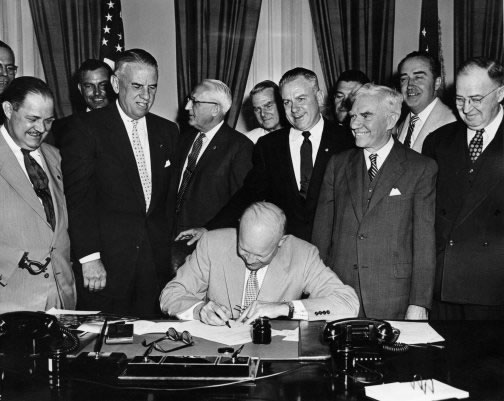
Originally, the focus was World War I. After World War II and Korea, honoring only one generation of veterans no longer fit the country’s experience. In Birmingham, Alabama, Navy veteran Raymond Weeks organized a 1947 event on November 11 to recognize veterans of all wars. The National Archives traces how that broader idea gained ground. In 1954, Congress changed Armistice Day to Veterans Day, and President Dwight D. Eisenhower signed the bill. Same date, wider circle of people to honor.
Image: President Dwight D. Eisenhower signs the 1954 bill changing Armistice Day to Veterans Day. Eisenhower Presidential Library and Museum / U.S. Government, public domain. Image source. Use does not imply government endorsement.

The long-weekend idea that moved a holiday
Then came a very 1960s Washington idea: put several federal holidays on Mondays. The Uniform Monday Holiday Act, signed in 1968, moved Washington’s Birthday, Memorial Day, Columbus Day, and Veterans Day to designated Mondays. The stated goals included more three-day weekends for federal workers, more travel, and fewer midweek interruptions to business. For Veterans Day, that meant the fourth Monday in October beginning in 1971. The National Archives’ record of the holiday schedule shows the October placement.
A long weekend is easy to sell. But this was not just another date that could slide around without changing what it meant. November 11 was tied to the end of World War I and to decades of local ceremonies. The federal rule also did not force every state and town to move with it. Some did; some kept November 11. Imagine trying to tell a veterans’ group its annual ceremony now belonged on the fourth Monday in October while the next town still planned for the eleventh. The conflict was built into the calendar.
October 25, 1971: the first test
The first October Veterans Day was October 25, 1971. The VA describes the observance as confused, with states disagreeing about the change. The problem was not that anyone hated weekends. It was that a date with a specific historical meaning had been treated like a movable appointment. An extra Monday off could not replace the “eleventh hour” story that schools, families, veterans’ organizations, and local communities already knew.
There is a useful distinction here. During the 1970s, the federal holiday fell in October, but November 11 did not disappear from American memory. The National Archives notes that celebrations split between October and November. That is why “Veterans Day was moved to October” is true as a description of federal law, yet too broad if it suggests everyone stopped marking November 11.
How November 11 came back
Veterans’ organizations and many states pushed for the traditional date. A 1975 bill to restore it reached President Gerald Ford. The Ford Presidential Library’s bill file describes confusion and resentment caused by the Monday holiday law and argues that the meaning of the date outweighed the commercial appeal of a long weekend. That is unusually direct for a government memo. The calendar experiment had become a contest between convenience and remembrance.
Ford signed the change on September 20, 1975. It did not snap back immediately: the law made November 11 the federal observance again beginning in 1978. That means the October version lasted from 1971 through 1977. The VA says the return reflected the wishes of most state legislatures, major veterans’ organizations, and the public. Whether every American knew the legal details is another matter; enough people knew which day they wanted.
What the date means now
Veterans Day is officially November 11 every year, even when that date falls on a weekend; a federal employee’s day off can be observed on an adjacent weekday under holiday rules. The VA’s Veterans Day facts also settle a smaller annual argument: it is Veterans Day, with no apostrophe. The day honors veterans of all U.S. military services. Memorial Day has a different focus: those who died in service.
That distinction is more interesting than a list of store discounts. Veterans Day can be a chance to ask someone about a part of service that rarely makes a parade speech: a person they served with, a place they went, or what they built afterward. The 10th Mountain veterans who helped shape Colorado ski towns and the Ghost Army veterans whose deception work stayed secret for decades are two reminders that service stories keep going after the uniform comes off.
So the next time November 11 arrives, remember the strange detour through October. America tried to turn Veterans Day into a more convenient Monday. Veterans and communities helped bring it back to the date that tells the story before anyone says a word: 11/11.