
Four identical coffins stood inside a French town hall. An Army sergeant was handed white roses and told to choose one. That choice would send an unidentified World War I American to Arlington National Cemetery, where the Tomb of the Unknown Soldier would become one of the country’s most recognized places of remembrance.
The sergeant was Edward F. Younger. His story is a fitting Veterans Day read because it involves more than a ceremony. It involves a combat veteran, a grieving French father, a voyage across the Atlantic, and a quiet return nine years later. Arlington National Cemetery’s account of Younger gives us the documented story behind the roses.
Why did an enlisted man get the choice?
Younger was not a general picked for a photo opportunity. Born in Chicago in 1898, he enlisted before the United States entered World War I, fought in France and was wounded twice. After the war, he served with American forces in Germany. He was among six soldiers assigned as pallbearers for the selection of the Unknown Soldier.
The Army originally planned for an officer to choose the casket. According to Arlington’s historian, Quartermaster General Harry L. Rogers learned that France had given the equivalent honor to an enlisted man. He allowed one of the American enlisted pallbearers to make the choice, and Maj. Robert P. Harbold selected Younger. It was an extraordinary assignment handed to a soldier who later described himself and his comrades as ordinary men.
That distinction matters. The Unknown was meant to represent service members whose names could not be recovered, not a single rank or famous unit. The man who chose him had fought the same war and understood that one of those caskets might have held someone he knew.
Four caskets, one spray of white roses
In October 1921, the Army brought unidentified remains from four American military cemeteries in France—Meuse-Argonne, St. Mihiel, Somme and Aisne-Marne—to Châlons-sur-Marne. The Army had taken steps to keep the selection truly anonymous. Early on October 24, officers rearranged the four caskets so that even their shipping cases would not reveal their origins. Younger entered the town hall and placed the roses on one casket. Arlington’s official Tomb history documents the selection and the precautions behind it.
Those roses were not just ceremonial decoration. Arlington’s research says Brasseur Brulfer, a former member of the local city council, donated them. He had lost two sons in the war; one son’s remains were never identified. A French father who could not point to his own son’s grave supplied the flowers that identified America’s representative Unknown. That detail makes the story feel less like a page from a protocol manual and more like what it was: families trying to honor people they could not bring home by name. Arlington’s history of the flowers traces that connection.
Younger later recalled circling the caskets and struggling with the decision. We can know what he wrote about that moment; we cannot know the identity of the man he chose. That uncertainty was the point of the selection, and it remains part of the Tomb’s meaning.
The long trip to Arlington
The chosen casket traveled by train to Le Havre, then crossed the Atlantic aboard the USS Olympia. It reached Washington on November 9, 1921, and lay in state in the Capitol Rotunda. Arlington estimates that about 90,000 visitors paid their respects during public visiting on November 10. Flowers kept arriving, many from people mourning someone with no known grave.
On November 11, 1921—then Armistice Day—the Unknown moved through Washington on a horse-drawn caisson to Arlington. President Warren G. Harding spoke at the funeral and placed the Medal of Honor on the casket. The original grave marker was a simple marble slab; the familiar sarcophagus was added in 1932. The date links the story to Veterans Day today, but the 1921 ceremony honored the unidentified war dead. Veterans Day now honors all who served. If you like the surprising history of the holiday itself, there is also the story of when Veterans Day moved to October and veterans helped bring it back.
Nine years before he returned
Younger returned to Chicago after his Army service and worked for the Postal Service. Here is the part that stays with me: the soldier chosen for that unforgettable task could not afford a trip to see the Tomb. Arlington’s historian says a Washington Post reporter found him in 1930, and the paper paid for him to visit on Memorial Day. Younger placed roses at the Tomb again, echoing the moment in France nine years before.
He said he might have eaten, slept and fought beside the Unknown. It was a possibility, not a claim that he recognized him. Younger died in 1942 and is buried at Arlington, in Section 18. The cemetery’s account describes him as a modest veteran who never tried to turn the Unknown’s story into his own celebrity.
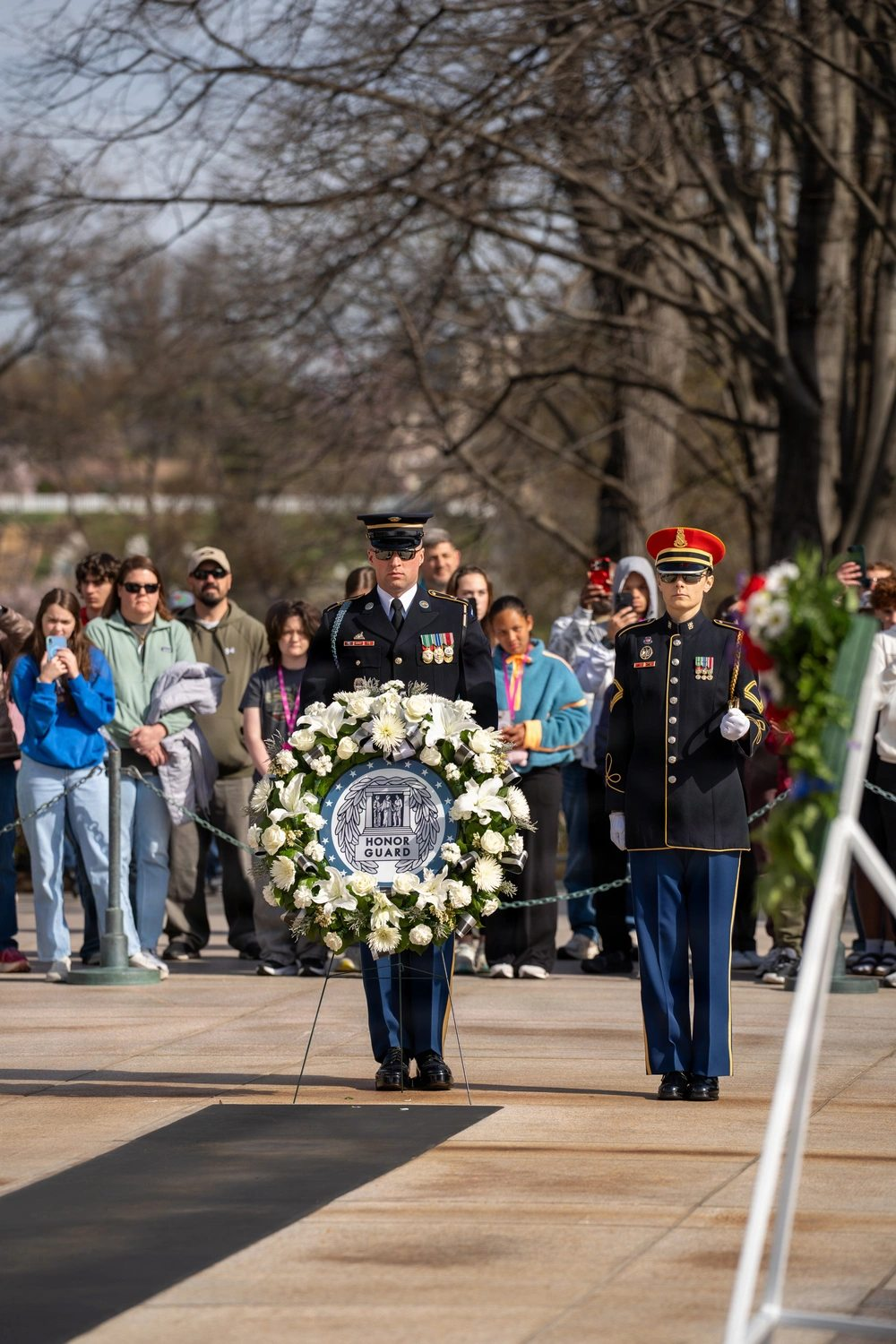
The Tomb’s guard is another part of this history that developed over time. Army soldiers first guarded it during daylight hours in 1926; round-the-clock watch began in 1937. The Old Guard took over in 1948. Today the precision is familiar, but the first tribute was a combat sergeant with flowers in a French town hall. Arlington explains the current guard ceremony.
What the roses still say
On Veterans Day, it is easy to picture the marble and the Sentinel. Younger gives that image a human starting point. Four caskets. A veteran asked to choose. Roses from a father who knew what an unknown grave meant. A soldier who finally came back years later because he wanted to honor someone who might have been one of his buddies.
And if the older identification methods interest you, the real story behind the notch in old military dog tags is another reminder of how much effort went into giving the fallen a name. At the Tomb, the name never came back. The honor did.
Featured photo: Soldiers of The Old Guard during a 2026 wreath ceremony at the Tomb of the Unknown Soldier. U.S. Army photo by Sgt. Samantha Cate, via DVIDS. This modern image does not depict the 1921 selection. The appearance of U.S. Department of War visual information does not imply or constitute DoW endorsement.