
In 2020, a family walking near Wiesbaden, Germany, spotted a silver chain in the dirt. Attached were two battered World War II dog tags, complete with the little notch on one end. The tags belonged to Pvt. Sammie Lee Williams. After some research, the family learned the ending they had hoped for: Williams survived the war, went home, and lived to be 81. The Army garrison shared the discovery decades after the tags had been lost.
If you have ever handled an old set of tags, you may have heard a much darker explanation for that notch. Supposedly it was designed to wedge a tag between a fallen soldier’s teeth. It is the kind of story somebody tells with total confidence at a museum display, and everybody else remembers forever. There is one problem: the Army says that was never the notch’s job.
So what was the dog tag notch actually for?
It held the blank tag in position in the machine that stamped the soldier’s information onto it. That is the explanation from the U.S. Army Quartermaster Museum’s history of identification tags. The museum describes the teeth story as a battlefield rumor and says it found no official record of soldiers being instructed to use a tag that way.
Notched tags appeared in the World War II era and remained in use into the early 1970s. When the equipment no longer needed that cutout to hold the blank, the cutout disappeared. A grim legend survived a very ordinary manufacturing change. The small groove was part of making the tag, not a secret feature for using it.
That correction does not make dog tags less serious. It makes the real story more interesting. A piece of metal you can lose in the couch cushions grew out of generations of soldiers trying desperately not to become an unknown name.
Before the Army issued tags, soldiers made their own
During the Civil War, soldiers sometimes pinned their names to their clothing, marked their belongings, or bought privately made identification pins and discs. The Quartermaster Museum describes men in Gen. George Meade’s army writing their names and units on paper before the 1863 Mine Run campaign. Imagine doing that before a fight: no speech, no ceremony, just making sure someone could tell your family who you were.
The Army had no standard government-issued tag then. Chaplain Charles C. Pierce later confronted the identification problem while working with soldiers’ remains in the Philippines. He recommended that the Army supply identification discs rather than leaving each soldier to improvise. Army regulations made tags mandatory in 1913, and by World War I, the discs were a familiar part of field service. The Army’s account of Pierce’s work shows why the change mattered: the point was to give a fallen service member a name, a record, and a way home.
The early tags were round. The oblong shape most veterans recognize came later. A U.S. Army Center of Military History artifact guide describes a World War I private who wore two discs: one could remain with his remains while the other helped the Army record what happened. That basic idea was much more important than the shape of the metal.
The stories the tags carried home
Williams’s tags in Germany are a nice reversal of what most people fear when they find wartime identification. His family’s story did not end in the woods where the chain surfaced. But another recovered tag shows why families can care so deeply about these objects. In 2016, an Italian couple brought a World War II tag they had found near Nettuno to the Sicily–Rome American Cemetery. The American Battle Monuments Commission traced it to Jerry J. Osterhouse and reached his sister, Geraldine. The commission reported that Osterhouse had been killed in 1944 while helping a medic aid a wounded soldier. More than 70 years later, his sister gained one more link to him.
These are different outcomes, and neither should be reduced to a spooky story about the notch. The tags mattered because the names on them mattered. That is why a found set can send somebody looking through records, across countries, or back into a family’s history.
What changed on modern dog tags?
The notch is gone, and the information has changed too. In 2015, the Army announced a shift away from printing Social Security numbers on newly issued tags, using a Defense Department identification number instead. Army Human Resources Command explained that the change would be phased in as tags were needed, especially for deploying personnel. That update addressed a modern problem older generations did not have to think about in quite the same way: what happens if a tag carrying a Social Security number is lost?
For many veterans, tags also take on a second life after service. They can sit in a drawer, hang from a mirror, or end up beside a P-38 can opener that somehow followed its owner home. Like a challenge coin, a tag can bring back a whole assignment or a particular person without saying much at all. The difference is that the tag’s first job was never nostalgia.
So the next time somebody tells you the notch was made for a fallen soldier’s teeth, you have the less cinematic answer ready: it helped the embossing machine hold the metal steady. Then tell them about the family in Germany who found Williams’s tags and learned he made it home. The rumor is memorable. The real history is better.
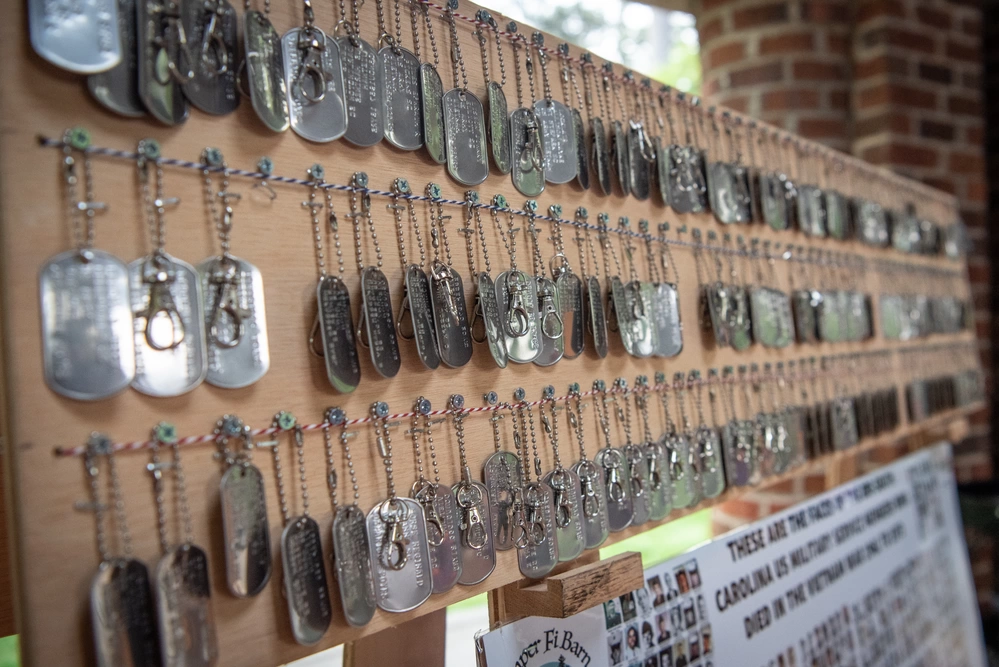
Featured photo: Dog tags in a Vietnam veteran display at Clemson University, photographed by Ken Scar for U.S. Army Cadet Command on April 15, 2023. DVIDS source. The appearance of U.S. Department of War visual information does not imply or constitute DoW endorsement.