
A coin hits the table. For half a second, everybody is still talking. Then hands go to pockets, wallets, and key rings. Somebody is about to find out whether this is a harmless challenge or an unexpectedly expensive round.
That little game is the loudest part of the military challenge coin tradition. The quieter part happens when a leader presses a coin into somebody’s hand after a job well done. One version gets a laugh. The other can stay with a soldier for decades. That is why a piece of metal you cannot spend can feel more valuable than the cash beside it.
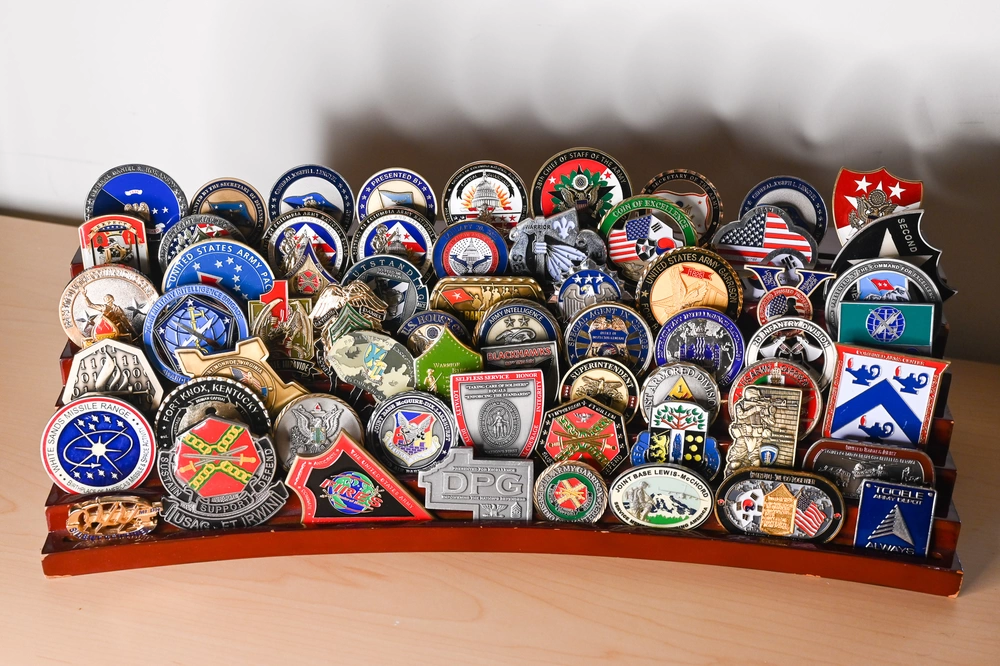
Featured photo: Challenge coins collected by Tech. Sgt. Andrew Enriquez, photographed at Joint Base Andrews in 2022. U.S. Air National Guard photo by Tech. Sgt. Andrew Enriquez via DVIDS.
What is a military challenge coin, anyway?
A challenge coin is usually a custom metal token carrying a unit emblem, a motto, a mission, or the identity of the person presenting it. Units make them to mark membership and shared experiences. Leaders also give them to recognize a specific person. A coin might commemorate a deployment, a school class, a promotion, or a moment when someone did more than the job description required.
There is no single story behind every coin. A Marine Corps DVIDS account of the tradition spoke with retired Army Master Sgt. Raymond Aguilar, who viewed coins as recognition for people who went above and beyond. Other coins are designed for a whole group. The object may look similar; the reason it matters can be completely different.
The coin check: simple rules, many local variations
Here is the version many service members know: somebody puts a coin on the table and calls a check. Everyone else has to produce a coin. If one person cannot, that person picks up the check. If everyone can, the challenger pays. That is how the game is described by service members in the Marine Corps story. A 2006 Army public-affairs account also describes Vietnam-era coin challenges in bars.
Of course, if you have ever watched a unit argue over whether a coin on a key chain counts, you already know the important caveat: these are customs, not one universal rulebook. The point is less about enforcing a regulation than having a reason to test who came prepared—and to tell the story of whatever coin gets slapped down.
That World War I origin story is a great story. It is still a legend.
You may have heard the tale of an American aviator captured in World War I who escaped with nothing but a squadron medallion. In the story, the coin proves his identity to suspicious French troops and saves his life. It is memorable enough that people repeat it as the birth of the challenge coin.
The trouble is that the documented origin is murky. The Marine Corps says the tradition cannot be traced to a specific time and place, and the Barstow account presents the aviator tale as one of several legends. A 2006 Army account recounts yet another explanation that a Coast Guard command master chief found in a 1969 issue of Soldier magazine. A printed retelling shows the story was circulating; it does not prove it happened as told.
So enjoy the pilot story the way you enjoy any good barracks legend. Just do not turn it into a historical fact because the guy telling it has a really impressive coin display.
A coin can turn the “wrong room” into a lifelong memory
Former Army Sgt. Maj. Jose Velazquez told Joint Base Myer-Henderson Hall’s newspaper about his first coin. As a young soldier in Panama, he walked into a room where Gen. Gordon R. Sullivan, then Army chief of staff, was speaking. Velazquez thought he had wandered into the wrong place. After the talk, Sullivan called him over, asked what he did, spent time speaking with him, and handed him a coin.
Velazquez later collected coins from senior leaders, including several Sergeants Major of the Army. Yet he still remembered that first one. What stuck was not the rank stamped on the metal. It was that Sullivan made a junior soldier feel as though he had the general’s full attention. Plenty of leaders can hand out an object; far fewer make the handoff mean something.

The class coin that escaped the class
Challenge coins are still getting new twists. In 2023, 2nd Lt. Michael Moser designed a coin for his Signal Basic Officer Leader Course class at Fort Eisenhower. He modeled it after a common access card. A class vote settled on the design; he initially ordered enough for his classmates. Then a photo hit social media and requests started coming from well beyond the class.
According to the Army’s December 2023 report, nearly 1,400 had gone to 32 states and eight other countries by the time it wrote the story. Retired soldiers reached out for one. Moser said the response helped bring people together. A coin shaped like the ID card everyone has wrestled with somehow became a little morale event of its own.
A good design catches a shared experience—in this case, the humble CAC. The metal becomes a souvenir of the joke and the people who understood it.
The coin you remember is not always the fanciest
Some coins are beautifully made. Some are odd shapes. But the one a veteran keeps within reach might be the plainest of the lot. The memory, not the manufacturing, gives it value.
The Army’s Moser story makes that distinction nicely: he described coins received from people he mentored as especially meaningful because they marked a human connection. And that is a good answer to anyone wondering why veterans save these things. You cannot buy back the exact people, place, or day. You can keep the reminder.
If small pieces of military life with oversized backstories are your thing, the P-38 can opener and the beloved woobie deserve a look too. Then pull out a coin—carefully, if someone else is paying attention—and ask the owner how they got it. The answer is usually better than the origin legend.
Images: DVIDS public-domain U.S. military visual information, credited above. The appearance of U.S. Department of War (DoW) visual information does not imply or constitute DoW endorsement.