
Picture getting a work order to cut down one tree. Now picture B-52 bombers overhead, fighter jets nearby, attack helicopters on call, and an aircraft carrier offshore. That sounds like a private’s exaggeration after a long field problem. In August 1976, it was the response to the killing of two U.S. Army officers at Korea’s Joint Security Area.
The name was Operation Paul Bunyan. The tree came down in about 42 minutes without another fight, according to an Eighth Army account. The remarkable part is why a maintenance job needed that much firepower. This was a deadly border crisis, and the United States and South Korea were trying to make a point without starting a war.
The tree was a security problem
At Panmunjom, the Joint Security Area sits along the Demilitarized Zone between North and South Korea. It is where opposing sides could come face to face under the Korean Armistice. A large poplar tree near the Bridge of No Return blocked the view between United Nations Command positions. Clearing those sight lines was practical security work, not somebody’s landscaping preference.
On August 18, 1976, Capt. Arthur Bonifas and 1st Lt. Mark Barrett led a work party to trim it. North Korean soldiers attacked the detail and killed both officers. The United Nations Command’s 2026 account identifies the date, the officers, and the mission. A tree that had been a visibility problem suddenly became the center of an international confrontation.
For anyone who has done a routine detail in uniform, the setup is almost too familiar: show up, take care of a small job, get back to the rest of the day. Here, the stakes were nothing like routine. Those two soldiers did not come home. Their names deserve to stay in the story, because the ridiculous-sounding scale of the operation can otherwise swallow the reason it happened.
Three days later, the engineers came back
On August 21, the United Nations Command returned. The plan had changed from trimming the branches to cutting the tree down. The 2nd Infantry Division’s history says a Republic of Korea special forces company, the 9th Infantry Regiment, and B Company, 2nd Engineer Battalion moved into the Joint Security Area at 7 a.m. The engineers had the saws. A much larger force made sure they could use them.
B-52s flew near the area with U.S. F-4 and South Korean F-5 escorts. F-111s were fueled and armed at Osan Air Base. The USS Midway task force had moved offshore. Eighth Army also describes artillery and attack helicopters supporting the mission. Put all that on a mission brief and the objective still reads: remove one poplar tree.
That mismatch is the shareable part of the story, but it was deliberate. A small, unprotected crew could have invited another attack. A raid against North Korean troops could have widened the confrontation. The allied force instead showed overwhelming readiness while giving its engineers a narrow, visible task. The U.S. Forces Korea account says forces massed along the DMZ and in the surrounding air and seas after the killings. This was signaling on a scale nobody in the area could miss.
According to Eighth Army, the engineers finished in 42 minutes. The tree came down without incident. The point was made, and the immediate confrontation did not turn into a new war. That’s a far more meaningful ending than the punch line about the world’s most heavily guarded tree service.
There is an important distinction when people retell this: the bombers and fighters were part of the show of force, not evidence that the allies bombed the Joint Security Area. The documented result was the removal of the tree. The dramatic aircraft list is real, but adding an imaginary airstrike makes the story less interesting, not more. The restraint is what made this operation unusual.
Why the strange mission still matters
Operation Paul Bunyan is often told for its absurd contrast: a chainsaw job backed by strategic bombers. It is a good story to pass to a buddy because every soldier knows the military can make a simple task spectacularly complicated. This time, though, the complication was the mission. The engineers were doing something concrete while commanders managed the risk of escalation. The goal was to demonstrate resolve and leave both sides a way to stop.
It also puts the Korean DMZ in sharper focus. From far away, a ceasefire can look like a settled border. At the Joint Security Area, a blocked view between guard posts could matter. The people assigned there operated at a point where a small encounter could have consequences far beyond the fence line. If you want another military history story that sounds invented but is well documented, the Castle Itter battle is in that category too.
The unit details are worth noticing as well. In a story dominated by aircraft, it was a combined South Korean and American ground team that went back to the exact place of the killings. Engineers performed the work while soldiers secured the area. That is a better picture of the mission than the shorthand version where a B-52 somehow handles yard maintenance. It was a team carrying out a limited task under a very large protective umbrella.
The story is still personal for the families. At the 50th commemoration in August 2026, United Nations Command reported that Bonifas’s grandchildren spoke about knowing their grandfather through his letters, and Barrett’s niece spoke about what a unit loses when one of its people is killed. The ceremony was about two men and the people who have carried their memory, not a clever operation name.
Camp Bonifas and the Barrett readiness center carry those names, according to Eighth Army. For readers curious about the Army career behind this site, Christopher Chaos’s background includes a later assignment in Korea. That was decades after 1976; the connection here is the place and its history, not a claim to have witnessed the operation.
So yes, the Army really brought bombers and a carrier to a tree-cutting mission. The soldiers who cut it down completed their job. The much harder job was making sure that, after the deaths of Bonifas and Barrett, the crisis ended there.
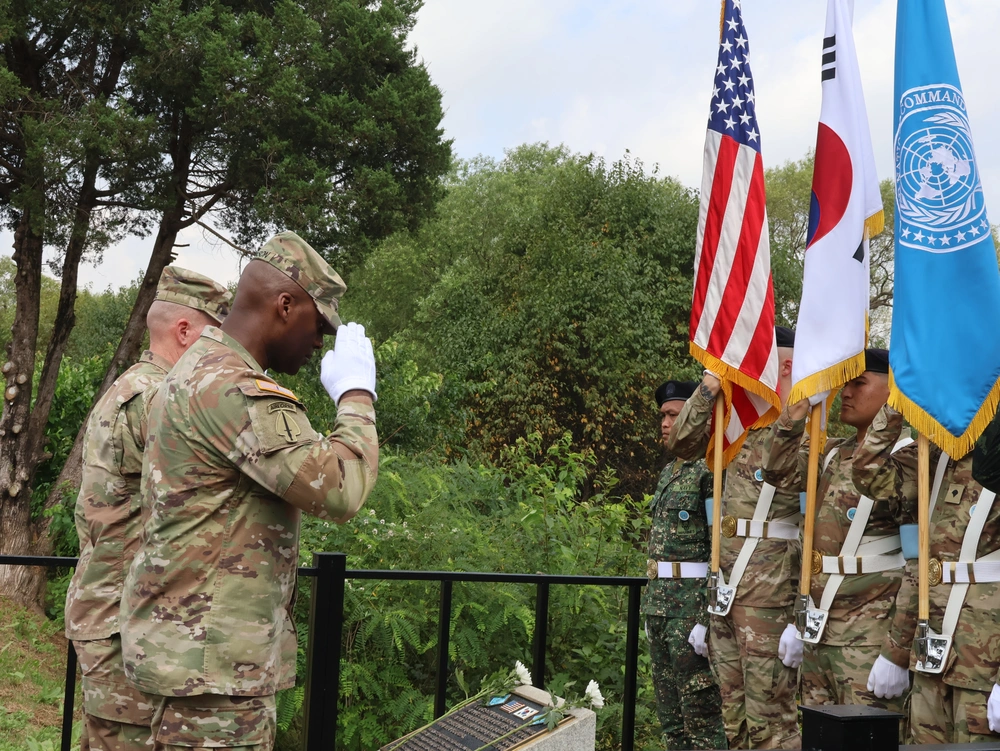
Featured photo: Gen. Xavier T. Brunson salutes the Bonifas-Barrett memorial at the Joint Security Area in 2025. This is a modern ceremony, not the 1976 tree-cutting mission. Photo by Lt. Cmdr. Brendan Trembath / United Nations Command via DVIDS (public domain). The appearance of U.S. Department of War visual information does not imply or constitute DoW endorsement.