
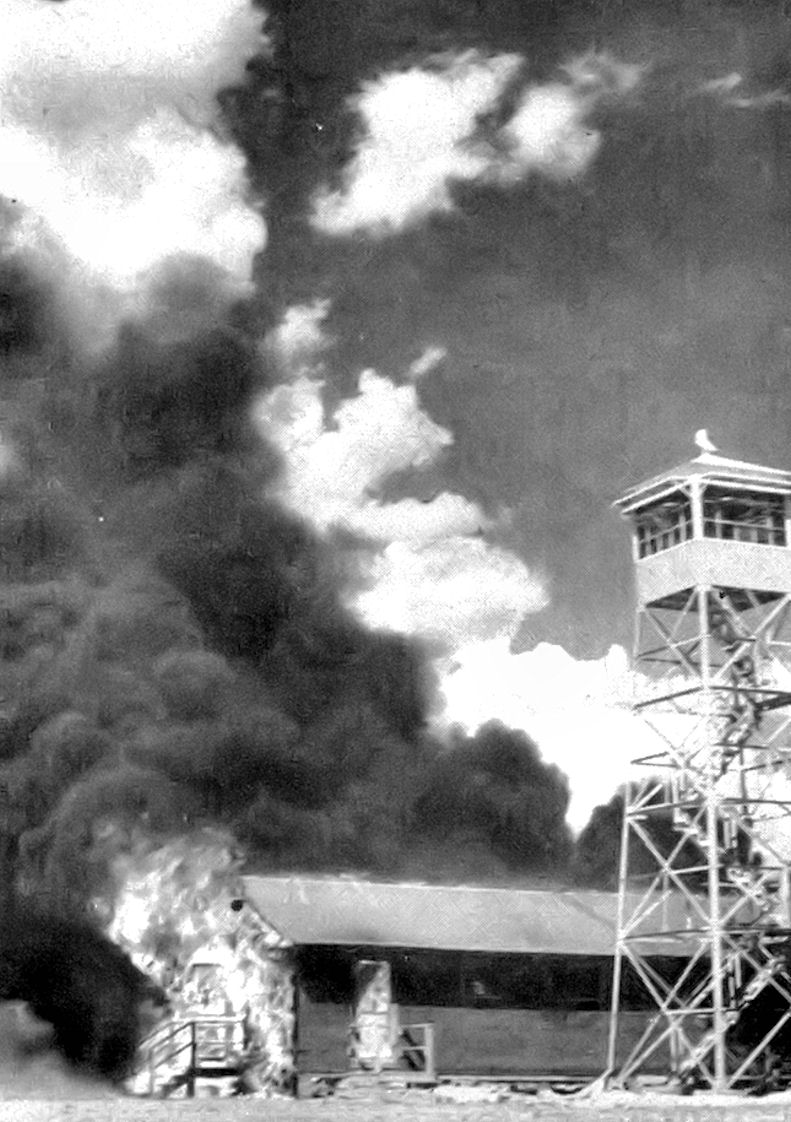
In 1943, a U.S. Army airfield in New Mexico caught fire during a weapon test. The trouble did not come from a bomber, a rocket or a careless cook. It came from bats carrying tiny incendiary devices. If that sounds like a rejected Halloween movie plot, the Army’s own history and a National Park Service account say otherwise.
For a brief stretch of World War II, the United States seriously explored turning bats into a way to start fires in Japanese cities. The plan never reached combat, but it did produce one of military history’s strangest test stories. The truly wild part is how much practical work went into making the idea plausible.
Featured photo: Smoke and flames at Carlsbad Army Airfield during the 1943 bat-bomb tests. U.S. Army Air Forces photo, via Wikimedia Commons; public domain in the United States. The date and exact extent of damage are reported differently in surviving accounts. U.S. military imagery does not imply Department of Defense endorsement.

A dentist brings bats to the White House
The idea came from Dr. Lytle S. Adams, a Pennsylvania dentist who had visited Carlsbad Caverns and seen its enormous bat population. In January 1942, only weeks after Pearl Harbor, Adams wrote to President Franklin D. Roosevelt with a proposal: release bats fitted with small timed incendiaries above Japan. The U.S. Army Military History Institute’s account says Roosevelt passed the notion along with a note calling it a wild idea worth examining. That is not quite the same as ordering a bat squadron, but it was enough to get a real military experiment moving.
The intended targets were wooden buildings in Japanese cities. Bats naturally look for dark crevices when daylight approaches. Adams hoped they would settle under roofs and inside structures before their devices ignited. The concept was ingenious in a grim way: put many small fires where ordinary incendiaries might not land. It was also a plan to burn populated places, so the funny headline should not hide the human stakes.
How was a bat bomb supposed to work?
Researchers focused on Mexican free-tailed bats, which could carry a small load relative to their size. The Army Air Forces and Chemical Warfare Service joined the effort, while scientists worked out a lightweight incendiary and a delivery system. The Army’s official Chemical Warfare Service history describes attaching a delayed device to each bat, cooling the animals into hibernation so they could be handled, and packing them into a container designed to open in the air.
In theory, the container would descend by parachute, the bats would warm up, fly away and find shelter, and the timers would start fires later. In practice, every step depended on a living animal following the plan. Some bats did not wake quickly enough after a drop. Others did wake and went wherever bats felt like going. Anyone who has ever tried to make a unit move on a precise timetable can appreciate the difficulty; now imagine the unit has wings and no interest in the briefing.
The device itself was not a cartoon sketch. A surviving U.S. Army Air Forces photograph of a bat-bomb canister shows a serious metal delivery system. This was an actual research program with equipment, test drops and people trying to solve a list of problems that only got stranger as they went.


The test that set the airfield on fire
During a 1943 test at Carlsbad Auxiliary Army Airfield, some armed bats escaped before the planned release. According to the National Park Service, warmth revived bats that had been laid out for photographs; they flew into buildings around the installation, and fires followed. The Army’s history likewise describes a photo opportunity that went wrong and damaged the airfield. The two official accounts differ on exactly how much burned, so the safest conclusion is the important one: the experiment started unintended fires on a U.S. military base.
That is a remarkable demonstration of both sides of the concept. Small animals really could carry incendiaries into places a conventional bomb might miss. They also did not know which side owned the buildings. It is hard to think of a faster way for a weapons test to explain its own control problem.
Why the military abandoned Project X-Ray
The Army eventually handed the work to the Navy, which used the name Project X-Ray. The Army’s Chemical Warfare Service history says the Navy passed it to the Marine Corps and canceled it in 1944 after learning the weapon would not be ready for combat until about mid-1945. The Army Military History Institute also points to uncertainty about its practical use. The bats were not deployed against Japan.
Some retellings make the ending sound as if the atomic bomb suddenly killed the bat bomb. That skips the documented chronology and the project’s own reliability problems. The military was still trying to make the bats wake, disperse and roost predictably. A weapon that can burn your own airfield has an awkward pitch for the next funding meeting.
A strange story with a serious edge
Project X-Ray belongs in the same conversation as the Army’s camel experiment or the Ghost Army’s battlefield deception: wartime ideas that sound invented until you read the records. Unlike the camouflage tricks, however, the bat plan was meant to spread fire through cities. That makes it a fascinating experiment to examine, not an adorable forgotten victory.
Still, if someone asks for a true military story to tell over Halloween weekend, this one is hard to beat. A dentist suggested it, the White House considered it, the services built it, and the bats gave their own field test of the plan. Their review was short, destructive and impossible to ignore.