
On Thanksgiving Day in 1944, an American soldier in a Bill Mauldin cartoon asks an officer about the changes he was going to make when he took over last month. That one question would do just fine on a command climate survey. If you’ve ever waited to see which parts of the new boss’s speech would survive a month on the job, you already get the joke. You can see the original panel in the Gilder Lehrman Institute’s Mauldin collection, page 42.
Mauldin made his name drawing Willie and Joe, two worn-out World War II infantrymen who looked as if they had been living in their uniforms because they had. Their audience knew what it was like to be cold, tired and in possession of several strong opinions they couldn’t put in a morning report. In Stars and Stripes, Mauldin gave those soldiers a place to see their own world on the page. One of the people reading was Gen. George S. Patton. He had some opinions too.
Willie and Joe looked like guys who’d missed a few shaves
Mauldin joined the Arizona National Guard in 1940. He began drawing for the 45th Infantry Division newspaper and later worked for Stars and Stripes, according to the Smithsonian’s Mauldin collection. He went overseas with the division and saw the fighting in Sicily and Italy. The Eisenhower Foundation traces Willie and Joe from the division paper to the Mediterranean edition of Stars and Stripes in 1943.
The characters’ faces had stubble, their clothing looked lived in, and their expressions did a lot of the work. A soldier didn’t need a narration box explaining that wet feet were making the whole day worse. Mauldin could draw a guy holding a pair of dry socks and trust the audience to understand what kind of friend would give up his last pair. The paper’s 1992 interview with Mauldin includes that cartoon and several others.
In that interview, Mauldin said the drawings had to ring true to infantrymen. He recalled once finding a small error in a drawing he couldn’t easily change, so he drew the rest backward and asked the newspaper to reverse the image when it was engraved. That is a lot of trouble for one panel. It also explains why guys who knew the equipment could relax and enjoy the joke.
War correspondent Ernie Pyle noticed the same thing while the war was still on. In a January 1944 column from Italy, he praised Mauldin for getting the details right and described his typical character as a 45th Division infantryman who had been through the mill. Pyle understood the difference between hearing about a line company and spending time with the people in it. His column gives us a contemporary account of the work, from someone who was there before anybody knew it would win a prize.
Patton didn’t see it the same way
Patton objected to the cartoons, and he met with Mauldin about the way he depicted American soldiers. The Eisenhower Foundation describes the confrontation, and the Oklahoma Historical Society’s Mauldin exhibit says the cartoonist kept drawing with the backing of Supreme Allied Commander Dwight D. Eisenhower. There are plenty of retellings with colorful dialogue. The part that matters is that an Army cartoonist kept his audience and kept publishing.
You can see why the drawings might bother a commander who prized military appearance. Imagine showing someone a sketch of your formation and having them ask which part of the uniform standard it’s supposed to demonstrate. Still, the details that looked bad on paper to one reader were exactly what made the paper worth picking up for another. The soldiers Mauldin drew could be competent, scared, loyal, sarcastic and sick of the weather all at once. They had room to be people.
A Pulitzer for the guys who looked exhausted
The 1945 Pulitzer citation singled out a cartoon with a caption in the style of a triumphant news report. The American troops are described as fresh and spirited. In the drawing, the Americans doing the work look exhausted. The gap between the caption and the picture is the whole joke. Veterans who have seen a cheerful official caption for a thoroughly miserable day can probably supply their own example.
Mauldin collected the wartime cartoons and stories in Up Front, published in 1945. Decades later he told Stars and Stripes that publishers hadn’t been sure civilians would buy a book about infantrymen. Readers did. You can see why someone back home would want to read it too. One face in a foxhole can get across a part of the war that gets lost in a map with arrows on it.
For another glimpse of an ordinary GI’s day, there’s the story of Claude Harwood catching every crumb of his turkey sandwich in 1944. The Army’s effort to get Thanksgiving dinner to Europe and what the meal looked like to one soldier are both true. Read the Army’s Thanksgiving turkey story. And if you want to know how a piece of issued gear can take on a life of its own, ask anybody who kept a poncho liner after getting out. Here’s the story of the Army woobie.
Willie and Joe worked because Mauldin trusted soldiers to laugh at something they recognized. An hour later, the rain was still coming down and the same job was waiting for them. But somebody else understood how it felt, and for a minute they had a good joke to pass down the line.
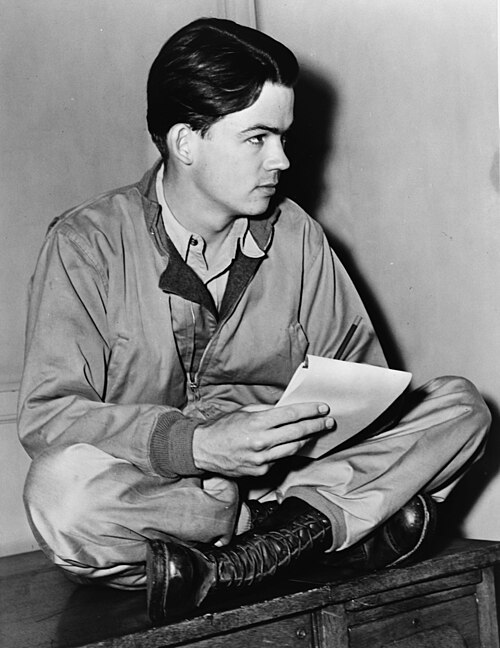
Featured photo: Bill Mauldin with his sketchpad in 1945. Photo by Fred Palumbo, New York World-Telegram & Sun Collection, Library of Congress Prints and Photographs Division, LC-USZ62-127496. Public domain. Photo source and rights.
