
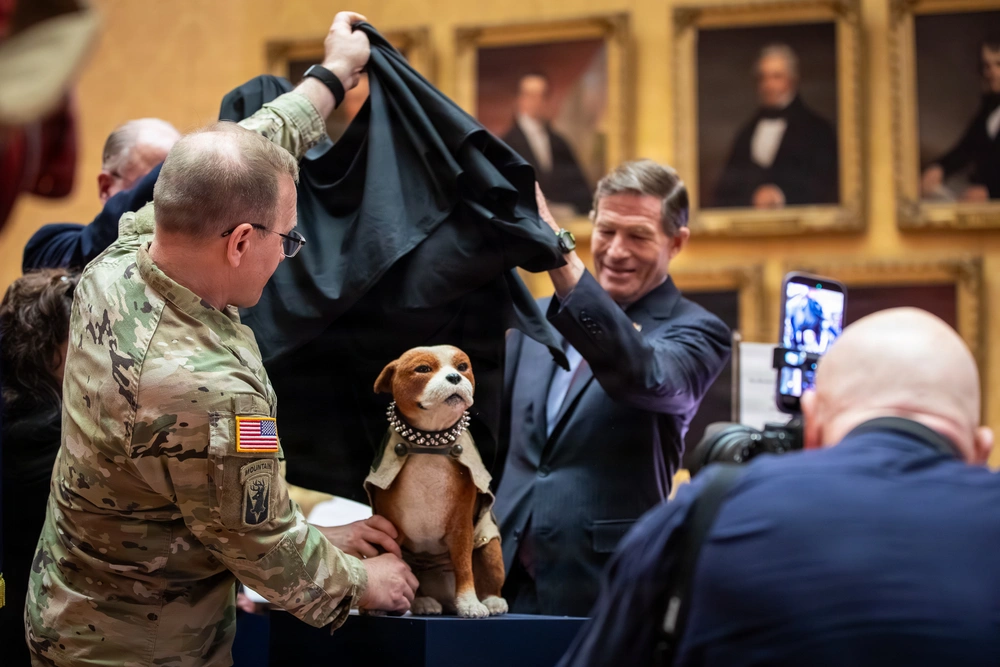
Featured photo: Connecticut National Guard leaders unveil a statue of Sgt. Stubby at the Connecticut State Library on April 20, 2026. This is a modern statue, not a wartime photograph of Stubby. U.S. Army National Guard photo by Spc. Emmanuel Gibson / DVIDS. The appearance of U.S. Department of War visual information does not imply or constitute Department of War endorsement.
In April 2026, soldiers and veterans gathered in Hartford, Connecticut, to unveil a statue of a short-tailed dog. Not a general. Not a politician. A stray who followed an infantry unit to World War I and came home with a name soldiers still remember more than a century later: Sgt. Stubby.
That sounds like a movie pitch. It is also a real piece of Army history, with a few legends that deserve a closer look. Stubby was a beloved mascot, a trench companion, and, according to accounts preserved by the Smithsonian, a dog who helped warn troops of danger. His “sergeant” title was honorary, which somehow makes the story more interesting—not less.
A stray walks into training
Stubby’s story began in 1917, while members of the 102nd Infantry Regiment were training near Yale University in New Haven. Private J. Robert Conroy befriended a small brindle dog with a short tail. The dog stayed around the soldiers, learned their routines, and became the mascot of the 102nd Infantry in the 26th “Yankee” Division. That basic outline comes from the Smithsonian’s collection record for Stubby, which now preserves him and his decorated blanket.
An infantry unit preparing for France had acquired an uninvited four-legged squad member. The men were heading toward trenches, artillery, and gas. Stubby stayed close to them.
When the unit shipped out, Conroy smuggled Stubby aboard the SS Minnesota. The story that Stubby saluted an officer and won permission to stay is part of the legend; a Smithsonian curator tells it as “the story goes”, not as a verified personnel action. The safer conclusion is still remarkable: a stray dog crossed the Atlantic with American soldiers and reached the front with them.
More than a morale mascot
A dog in a World War I trench was not going to stop artillery. What he could do was notice things people missed. The National Museum of American History recounts Stubby barking a warning when he sensed gas, helping soldiers get their masks on. The museum also credits him with finding wounded men and drawing attention to them until help arrived.
In a place where a few seconds could matter, a dog’s nose and ears were useful. So was his company. Dogs served as messengers, guards, and companions during the war, even though the United States did not yet have a formal military dog program.
Stubby also got hurt. During the Battle of Seicheprey on April 20, 1918, shrapnel wounded him. The Smithsonian says he was treated at a field hospital and then recovered at a Red Cross hospital, where he spent time around wounded soldiers. A mascot visiting the ward may not be the sort of achievement that gets plotted on a campaign map. Ask anyone who has had a rough day far from home whether it matters.
Then there is the most cinematic part of the tale: Stubby is credited with catching a German soldier near Allied lines, biting him and holding on until American troops arrived. The Smithsonian records the incident, while retellings differ in details such as whether the man was a spy. It is a good story without adding an imaginary courtroom transcript to it. The museum says Stubby’s unofficial promotion to sergeant followed that episode.
Was Sgt. Stubby really in the Army?
Here is the distinction worth keeping straight. Stubby accompanied soldiers and earned their affection, but he was a unit mascot, not an enlisted soldier with a formal rank. The Smithsonian calls his promotion unofficial. An Army account likewise describes him as an honorary mascot and dates the Army’s official War Dog Program to World War II. “Sergeant” is the name history gave him, not evidence of a dog-sized set of orders.
The Smithsonian places Stubby in 17 battles and describes his gas warnings, wounded-soldier searches, and shrapnel injury. The rank was an affectionate way of recognizing a member of the team who did not need a uniform to belong.
From the trenches to Georgetown
After the war, Stubby’s life took a turn that most veterans would call a pretty good transition plan. He went home with Conroy, appeared in parades, met General John J. Pershing, and visited the White House. One of his medals came from the Humane Society and was presented by Pershing, according to the Smithsonian record. It is important not to turn that into a claim that the Army awarded him a human combat decoration.
Conroy later studied law at Georgetown, and Stubby went to campus too. Georgetown University Library says Stubby became a football mascot and nudged a ball around the field at halftime. From muddy trenches to working a college crowd: the dog had range.
When Stubby died in 1926, Conroy eventually donated his preserved remains to the Smithsonian. He is part of the museum’s military history collection today. The story has been retold in books and film, which can make the line between documented history and irresistible embellishment hard to spot. The dog did not need extra medals or an invented service record. What is documented is plenty.
Why soldiers still remember him
The Connecticut National Guard reported that the statue unveiled this April brought current soldiers, veterans, and Conroy’s family together. Curt Deane, Conroy’s grandson, spoke about the family’s bond with Stubby. A century later, people were still showing up for the little dog who showed up for an infantry regiment.
Maybe that is the part worth sharing with a buddy. Military history is often told through commanders, weapons, and big arrows on maps. Sometimes the most memorable member of a unit is the one who had no idea what a campaign was, but knew exactly who his people were. If you like stories about unlikely Army legends, the Ghost Army’s inflatable-tank deception and the enduring affection for the humble woobie are two more good places to go next.